


Counteracting the shortage of skilled workers with digital instructions
Particularly in view of the sharp rise in the shortage of skilled workers and the rapid development of business processes and technologies, the sustainable safeguarding and targeted use of corporate know-how is crucial to a company’s success.
But how does a company manage to retain its knowledge on an ongoing and structured basis and always make it available to its employees at the required time and place? The tepcon solution to this challenge is called instructor.
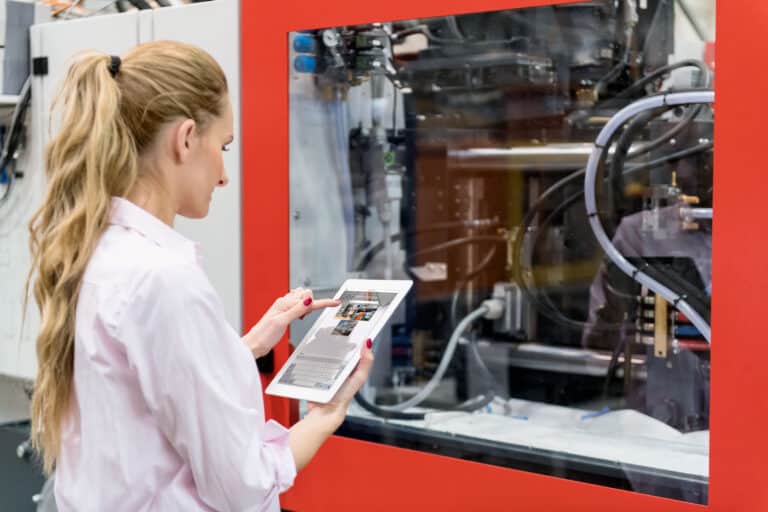
This is a solution for the B2B sector that combines two key components. Firstly, all data, e.g. instructions and documentation, is stored centrally on an IIoT portal. Secondly, instructions and documentation are created and made available to employees, partners or customers via the instructor.
The advantages that can be achieved and how the whole thing works can be perfectly illustrated using the case study of instructions.
The creation of conventional instructions is very time-consuming. In practice, this often results in That instructions are only partially available, as the focus is on day-to-day business; that these are often available in a wide variety of forms, depending on which employee feels most comfortable with which program, and that archiving is also often chaotic and not centralized. The resulting database is therefore incomplete. Valuable know-how is lost and cannot be retrieved when needed.
By introducing instructors as a comprehensive instruction management system, employees can record all future instructions quickly and easily from the “first-person perspective” using a standard smart device without interrupting their daily work. The individual steps are recorded directly on the object/product and provided with annotations, images, audio and video recordings. Checklists and important safety instructions can also be recorded. Once saved, the instructions are stored centrally in the IIoT portal and are immediately available for other users to access. Subsequent changes can be made at any time. A module for automatic translations can also be integrated. An integration option for learning management platforms is also available.
However, it is not only the processes of recording, archiving and providing know-how that are optimized. The application of the digital instructions themselves also leads to far more effective results than is the case with conventional instructions. Clear step-by-step instructions provide the employee with maximum support in carrying out the task. He/she carries out the work steps interactively, faster and with a lower error rate. The learning effect of using AR-based instructions is also demonstrably higher. Shorter training periods for new employees or faster learning of new tasks can be achieved through the use of instructor.
Conclusion: Knowledge, as the only resource that is not consumed by continuous, practical application but increases in value, is invaluable for every company. The instructor solution helps to organize this intellectual company capital in a sustainable, structured and targeted manner and to transfer it efficiently within the company. Our appeal to the industry is therefore: Rethink now! Digitize your corporate know-how.