
Versatile areas of application from production to quality assurance and service


Documentation: Create instructions
The documentation of work instructions and manuals in production is crucial for consistent product quality and efficient processes. At the same time, it presents companies with the challenge of providing information that is up-to-date, comprehensible and accessible to all employees.

Problem
Writing instructions is laborious and time-consuming.

Consequence
No or incomprehensible instructions are created.

Solution
Instructions can be created in minutes with the instructor.

Benefit
The employees write instructions and thus secure the knowledge in the company.
Industry: shortage of skilled workers
The shortage of skilled workers in manufacturing poses major challenges for companies: Fewer and fewer qualified workers are available for increasingly complex production processes. This development not only jeopardizes efficiency, but also the innovative strength of the entire industry.

Problem
Employees go on vacation, fall ill or retire.
Loss of knowledge
Counteracting the shortage of skilled workers

Consequence
Knowledge is lost. Problems have to be laboriously solved again and errors occur.

Solution
With the instructions from the instructor, even semi-skilled employees can take on complex tasks with confidence.

Benefit
The knowledge remains in the company – and you remain capable of acting in any situation.
Industry: Quality assurance
Digital instructions guide employees step by step through inspection processes. They ensure standardized processes and significantly reduce inspection errors. This ensures product quality and increases efficiency in quality assurance.

Problem
There are no inspection instructions and the employees inspect individually at their own discretion.

Consequence
This increases the risk of errors and leads to quality deviations and reworking in the field.

Solution
The inspection instructions in the instructor guide employees safely and consistently through inspection processes.

Benefit
Product quality is assured and quality assurance efficiency is increased.
Industry: familiarization and training
Training new employees is often time-consuming and error-prone. A lack of knowledge and uncertainty slow down the onboarding process. Well-structured instructions create clarity, standardize processes and thus make it noticeably easier to get started.

Problem
The induction and training of employees is time-consuming and resource-intensive.

Consequence
Training is reduced to the bare essentials and the teacher’s capacity is lacking in operational business.

Solution
With the instructor, employees can familiarize themselves with processes independently and access the training content in the field.

Benefit
Employees receive standardized training, resources are conserved and business operations are not interrupted.
Production: Variant production
The documentation of variants in assembly poses a number of problems. Many work steps are repeated, while others differ between the variants.

Problem
All variants are summarized in a guide at
.
Individual instructions are created for each variant.

Consequence
The instructions become confusing, which leads to quality problems and errors
Individual instructions lead to redundant content and increase the administrative effort many times over.
Solution
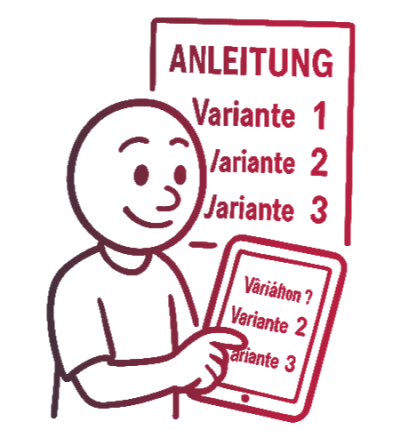
All variants are managed in a manual and the work steps are assigned to the variants.
Only the relevant work steps are displayed when the instructions are carried out.

Benefit
The complexity of variant production is reduced and employees are guided through processes efficiently and error-free.
The administrative effort is reduced to a minimum.
Service: Availability and access to instructions
The challenge in service is often that the required instructions are difficult to find, incomplete or out of date. Especially in mobile use, there is a lack of quick, situation-specific access to up-to-date information. As a result, service employees have to improvise or call colleagues – which costs time, disrupts processes and increases the risk of errors.

Problem
Finding and accessing the required instructions is time-consuming.

Consequence
Employees prefer to call their colleague and ask for advice, interrupting them in their work.

Solution
With the instructor, the employee can call up the right instructions in the right version in seconds using a QR or barcode.

Benefit
It is more convenient for the employee to call up the instructions digitally than to disturb a colleague. This saves time, money and nerves.
Service: Process reliability
Verbal work instructions are often not fully remembered or interpreted differently. Important steps can be forgotten – especially with new or changing employees. This leads to errors, queries and unnecessary additional work.

Problem
Without instructions, the processes must be explained verbally to each employee.
Process reliability
Digitize business processes
Induction of new employees

Consequence
Verbal instructions are not sustainable, steps are forgotten, errors occur and additional work is required

Solution
QR code links at the workstation give employees direct access to instructions.

Benefit
Process reliability is guaranteed across all employees and locations and the work results are recorded.
Materials management: incoming goods inspection
If there are no clear inspection instructions for incoming goods, the inspection is heavily dependent on the individual employee. Everyone checks at their own discretion – sometimes too superficially, sometimes too elaborately. This leads to inconsistent results and increases the risk of faulty or incomplete goods being overlooked. The consequences can be seen later in production: unplanned downtime, rework and high follow-up costs.

Problem
Without inspection instructions in the incoming goods department, goods are often checked unsystematically and are prone to errors.

Consequence
Defective parts enter production, causing downtime that also affects downstream departments

Solution
With instructor, employees receive digital inspection instructions and can document and report deviations directly.

Benefit
Quality is assured, processes are standardized and expensive reworking and downtimes are significantly reduced
Shipping: packaging and order picking
The packaging of transport-critical goods requires special care and clear guidelines. A lack of knowledge or inconsistent processes can quickly lead to transport damage. Without standardized instructions, the risk of complaints and loss of time increases – and in the event of damage, the company is also obliged to provide evidence.

Problem
If employees do not know how to pack transport-critical goods correctly and no instructions are available.

Consequence
If goods are not packaged correctly, they arrive damaged and cause complaints and additional costs.

Solution
With the instructor, employees receive clear packaging instructions and document how the goods have left the company using checklists and photos.

Benefit
Securely packaged goods ensure satisfied recipients, fewer complaints and protect the sender from liability risks.

Do you also need so much time to create instructions?
Digitize your operating, assembly and service instructions with the “instructor”.

Do you still record your processes on paper?
Our software solution is the more efficient and sustainable alternative for documenting activities in your production.

Are your costs for quality assurance also too high?
With the tepcon “instructor” you reduce errors, increase quality and reduce costs.

Do you also need to counteract the shortage of skilled workers?
Our user-friendly software helps you to record and pass on specialist knowledge.
We are delighted with the trust placed in us by many satisfied customers!