


Artificial intelligence: how AI is revolutionizing industry and production
Whether for the precise monitoring of machines, the intelligent control of robots and vehicles or the optimization of energy consumption – the importance of artificial intelligence (AI) for industry is growing rapidly. More than 40 percent of industrial companies in Germany already use AI in production. A further 35 percent are specifically planning to use them.
An overwhelming majority of companies are convinced that AI will be decisive for the competitiveness of the German economy in the future. At the same time, almost half of those surveyed warn of the danger of oversleeping the AI revolution.
Industry 4.0 networks people, machines, systems, products and processes into a dynamic unit. Artificial intelligence is the key driving technology here: it analyses huge amounts of data, recognizes patterns, reacts in real time and controls complex processes independently.
From predictive maintenance and automated quality control to intelligent supply chains – the potential applications are diverse and extend across all industries.
The role of AI applications is already revolutionary – reason enough for us to take a closer look at the topic of artificial intelligence in a separate knowledge text.
Find out below how AI is being used in industry today, what the benefits and challenges are and how digital work instructions with the tepcon instructor and instructor AI can make your production processes future-proof.
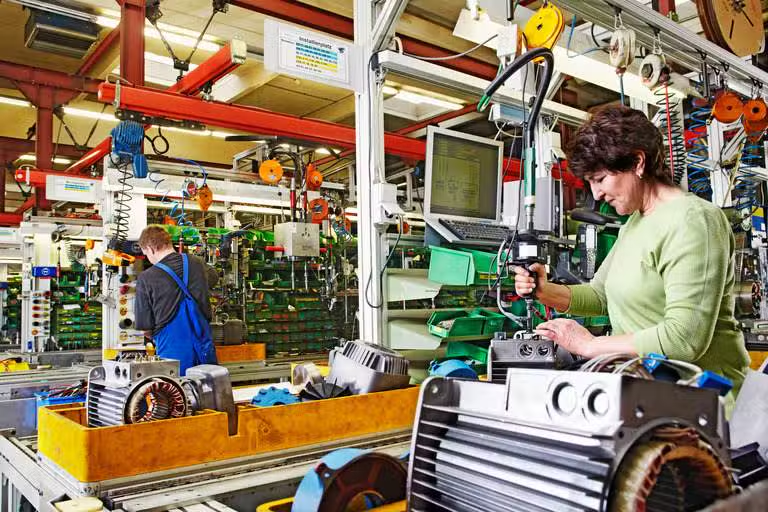
AI in the industry
Definition at a glance:
Artificial intelligence is a branch of computer science that enables systems to solve tasks that normally require human intelligence – such as perception, learning, decision-making and problem-solving.
In industry, AI has evolved from a research topic to a living reality. While the first use cases mainly took place in laboratory environments, today almost all areas of the value chain are affected: from product development to production and logistics.
The role of AI in industry is far more than automation: it enables systems that make decisions independently based on data, optimize processes and adapt to new conditions. Machines learn to predict errors, robots adapt their movements dynamically and entire factories react flexibly to fluctuations in demand.
The development is rapid: driven by growing computing power, improved AI technologies and the ever-increasing availability of data volumes, the importance of artificial intelligence in industry has multiplied in a very short space of time.
Are you in a hurry? Click here to go directly to our product, the tepcon instructor!
AI systems and their possibilities
Modern AI systems offer a variety of technologies and methods that make manufacturing processes more efficient, flexible and predictive.
Modern companies are increasingly relying on machine intelligence because the potential is huge. Various methods offer solutions, depending on the industry, application and problem. Anyone who deals with AI industry applications will often stumble across certain terms.
Machine learning
Machine learning is a core area of artificial intelligence (AI). It enables systems to learn from data, recognize patterns and make predictions – without being explicitly programmed for each task. In production, for example, machine learning can be used to optimize processes, for quality control or for fault diagnosis.
Example: An ML algorithm (machine learning algorithm) continuously analyzes sensor data from systems, detects deviations and makes suggestions for preventive measures.
Predictive maintenance
Predictive maintenance is one of the best-known use cases for AI in industry. AI systems use real-time data and historical values to calculate the optimum time for maintenance work. This reduces downtime, cuts costs and extends the service life of machines.
This offers an opportunity for cost savings and predictability: instead of expensive emergency repairs, maintenance can be planned. Industrial companies gain planning security and increase their productivity.
Edge Computing
Edge computing refers to the processing of data directly where it is generated – at a machine or sensor, for example – instead of first sending it to a central data center. In combination with AI software, this enables an extremely fast response in time-critical production processes.
Advantage: In factories, robots or systems can react to changes in milliseconds, without delays caused by long data transmissions.
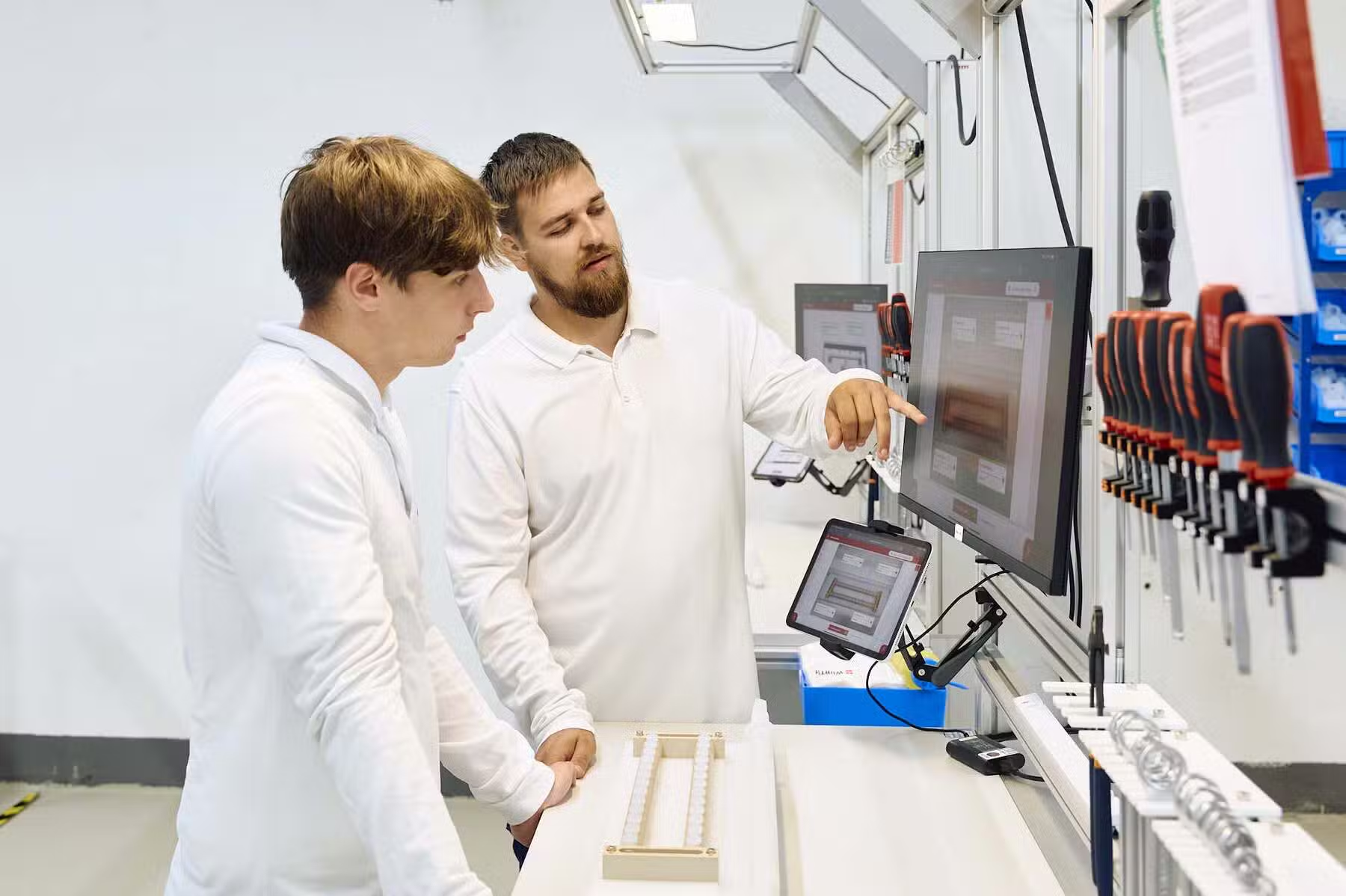
AI applications – with artificial intelligence into Industry 4.0
Industry 4.0 stands for the complete networking and digitalization of production. AI applications are the engine that enables the intelligent control of processes.
Artificial intelligence enables companies to improve their product quality, reduce waste and increase efficiency at the same time. Data volumes generated by sensors, production systems and digital twins provide the basis for intelligent systems.
The importance of AI technologies is particularly evident in the area of human-robot collaboration: robots are becoming capable of learning, adapting flexibly to new products and working safely alongside humans.
Fields of application that are already being used in many companies today are, for example:
- Online monitoring and anomaly detection
- Adaptive control of production processes
- Simulation of production processes
- Human-robot collaboration for flexible production
- Automated quality inspection
The importance of these technologies is growing, as they bring products to market faster, stabilize supply chains and generally increase the competitiveness of companies.
Book your personal demo and experience the benefits directly!
Areas of application for artificial intelligence in Industry 4.0
Let’s take a look at where AI systems are used in the company, or more precisely: how AI in industry helps to optimize processes and production in general.
01
Production
In production, AI software ensures greater precision, better quality control and flexible adaptations to changing production processes. Robots, for example, recognize components independently, adapt their movements and work safely with humans.
02
Logistics
In logistics, AI systems analyze delivery times, routes and storage capacities in order to reduce costs and shorten throughput times. Possible applications range from automated vehicles in factories to intelligent warehouse systems.
03
Maintenance / Predictive maintenance
Predictive maintenance is a prime example of the use of AI in industrial companies. The continuous evaluation of sensor data enables predictive maintenance and reduces unplanned downtime. This saves money, time and personnel – in the long term.
04
Quality control
AI applications also help in quality management: Automated image processing with AI detects even the smallest errors that are barely visible to humans. This improves product quality and reduces costs.
05
Energy management / sustainability
AI technologies optimize energy consumption and help to reduce CO₂ emissions. The potential for sustainability is high, especially in energy-intensive industries.
For example, intelligent control systems in production halls can automatically adapt the operation of machines by recognizing idle times and switching systems to energy-saving modes when they are temporarily not needed.
In energy-intensive processes such as metal or glass processing, AI algorithms continuously analyse sensor data from industrial furnaces and control the use of energy so precisely that temperature fluctuations are minimized and the consumption of gas or electricity is significantly reduced – without compromising product quality.
Use of AI in your own company: Risks, challenges and securing the future at the same time
The use of AI not only brings advantages, but also challenges:
- Legal requirements and regulation must be complied with
- Data security must be guaranteed
- Innovation costs are often high
- Acceptance among employees can vary
- Technical integration into existing systems requires specialist knowledge
Solution approaches
- Step-by-step introduction in clearly defined use cases
- Employee training
- Selection of suitable AI solutions that are compatible with existing systems
- Cooperation with start-ups and technology partners
- Increase productivity through automated processes
- Relieving employees of routine tasks
- Analysis of large amounts of data for pattern recognition
- Improving product quality
- Optimization of supply chains
- Less downtime thanks to predictive maintenance
- More flexible production thanks to adaptive robots
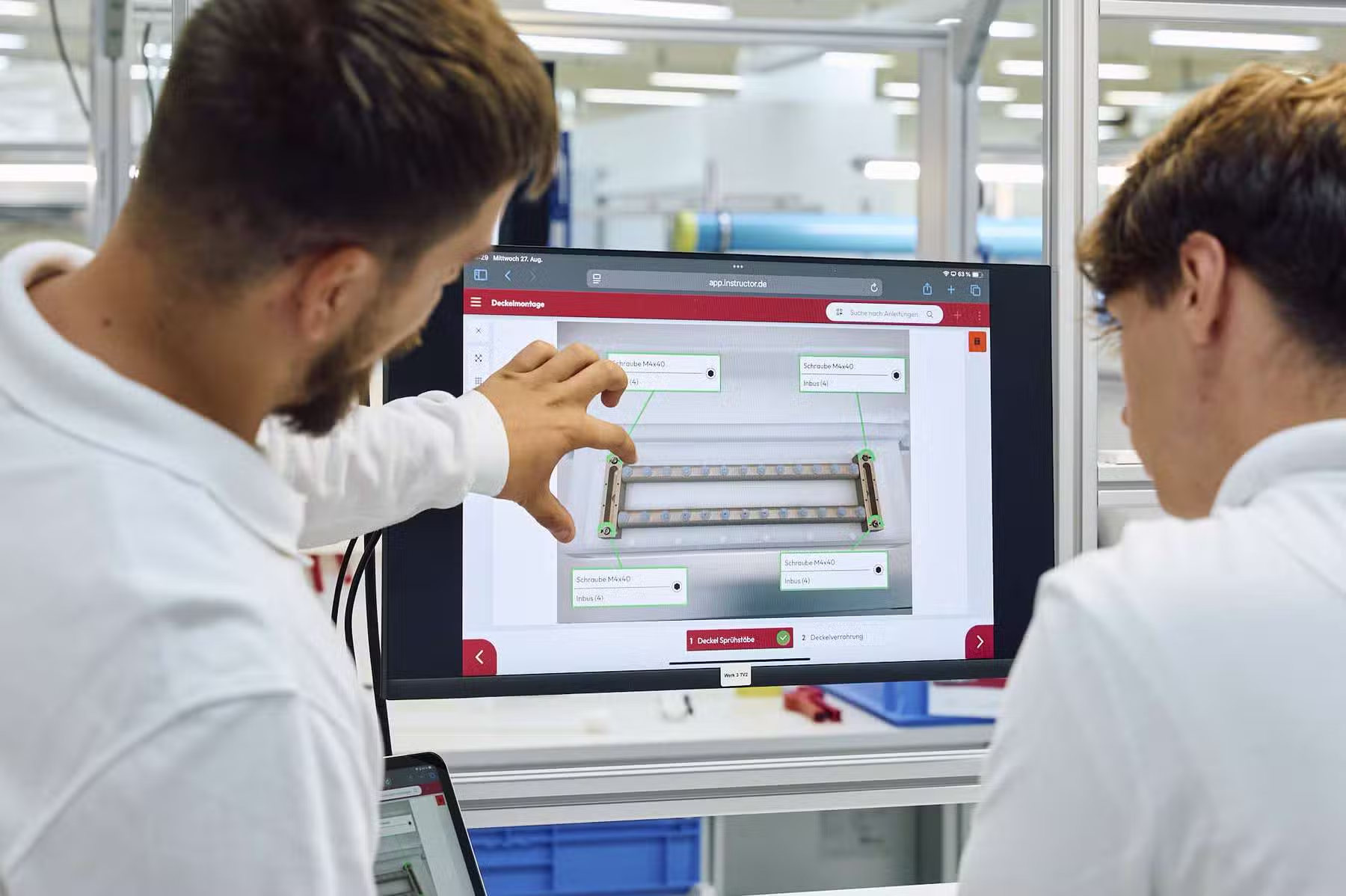
Digital work instructions as part of artificial intelligence
Digital work instructions are a key component of Industry 4.0.
Combined with AI technologies, instructions can be automatically created, optimized and adapted to changing conditions in real time. We have also recognized the advantages of artificial intelligence for our product, the tepcon instructor: with the implemented instructor AI function, we use the full potential of machine intelligence.
instructor AI: reliable instructions in seconds
Creating clear, comprehensible work steps is often time-consuming and postponed in many companies. The instructor AI takes on this task automatically: based on images, symbols and labels, it generates precise description texts with a click.
Short, concise summaries – ideal for quick orientation or full-text searches – are also created automatically from titles, step names and descriptions. The AI adapts to the style of the respective user in order to optimally adapt content to the target audience.
Particularly valuable: changes to instructions are automatically documented. Instructor AI creates complete release notes from the change tracking and version comparison – quickly, clearly and seamlessly.
Thanks to AI, digital instructions and worker guidance become time and cost efficient in a matter of minutes.
Get detailed advice on the tepcon instructor or start the test phase right away!
Outlook: How AI will change the industry in the future
Artificial intelligence will fundamentally change industry in the coming years by making production processes even more automated, individualized and networked.
Thanks to increasingly powerful algorithms, machines can make complex decisions in real time, recognize patterns in huge amounts of data and react immediately to changes in production. This not only enables greater efficiency, but also unprecedented flexibility in production – for example, through the seamless changeover to new product variants or the predictive maintenance of systems.
At the same time, AI will revolutionize quality assurance, as it allows sources of error to be identified at an early stage and rejects to be minimized.
In combination with technologies such as edge computing, robotics and the Industrial Internet of Things, a new generation of intelligent factories is emerging that work almost autonomously. Companies that embrace these developments at an early stage will secure decisive competitive advantages in an increasingly data-driven market environment.
Get started now in AI-supported Industry 4.0 – with the tepcon instructor for safe, efficient and digital work instructions.
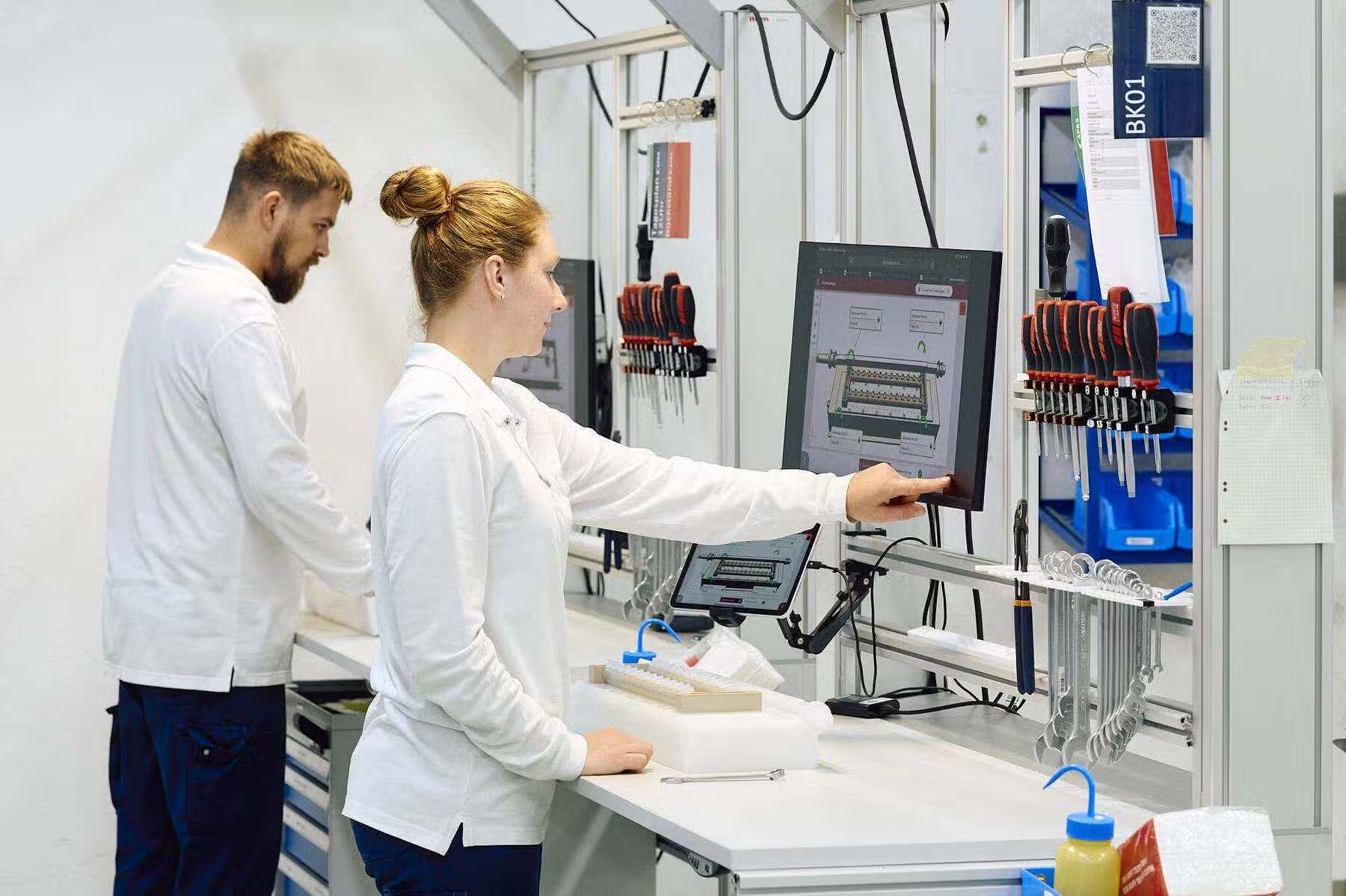
FAQ on artificial intelligence in the industry
What is the difference between artificial intelligence and machine learning?
Machine learning (ML) is a sub-area of this intelligence in which systems learn from data and continuously improve without being explicitly programmed. While AI therefore encompasses the entire spectrum of intelligent technologies, machine learning focuses on the development of algorithms that derive patterns from large amounts of data.
In Industry 4.0, both technologies are important for increasing automation, quality and efficiency in production.
How do small and medium-sized enterprises benefit from AI?
One example: AI solutions allow production systems to be maintained with foresight, minimizing downtimes and improving product quality.
For many companies, this is a crucial way to secure their competitiveness in the German and international economy. AI offers smaller industrial companies in particular the opportunity to keep pace with major players because they can make data-driven decisions faster and more precisely.
How is AI used in the manufacturing industry?
In production, for example, AI systems can analyze images of products in order to detect errors in real time. In the field of automation, intelligent systems control machines so that resources are used optimally. Another example is the analysis of supply chains in order to predict bottlenecks and take proactive countermeasures. These solutions not only increase efficiency, but also the flexibility of the way industrial companies work, which is a clear advantage in global competition.
What requirements are necessary for the use of AI in production?
First of all, sufficient and high-quality data must be available, as this forms the basis for the development of powerful AI systems. Suitable technical infrastructures are also required to operate AI solutions in an industrial context. Employee training also plays a key role in using the new systems efficiently. Finally, industrial companies need to consider the legal framework and possible challenges in terms of data protection and regulation.
What are the challenges of introducing AI in industry?
In addition to technical development and integration into existing systems, data quality is a particularly critical factor. Incomplete or unstructured data can severely impair the success of AI projects.
There are also organizational issues, such as the adaptation of business processes or acceptance within the workforce. In the context of regulation and ethical guidelines, industrial companies must also ensure that AI is used responsibly. Nevertheless, for many companies, the opportunity to increase their competitiveness in the long term through AI outweighs this in the decision-making process.
What potential does AI have for the future of Industry 4.0?
In future, AI systems will be linked even more closely with other technologies such as the Internet of Things (IoT) and cloud solutions to enable completely new business models. This will enable companies to manufacture products more individually, faster and with fewer resources.
One example: In flexible production, machines can be adapted to changing customer requirements in real time. For start-ups and established industrial companies, this offers a unique opportunity to increase their productivity and grow in international competition in the area of innovation and development.