


Inhaltsübersicht
- 1 Definition of process optimization
- 2 Basics of process optimization
- 3 Excursus: Nudge management, a method with a focus on the human factor in business processes
- 4 Process optimization goals – why does my company need this?
- 5 Lean management
- 6 FMEA
- 7 First steps
- 8 Selection, analysis, optimization – and everything from the beginning
- 9 Support with process optimization
- 10 Practical example: tepcon provides the tool for work instructions, worldwide
- 11 Work instructions via software
- 12 Digital, multilingual work instructions for mechanical engineering
- 13 Make an appointment for your initial consultation!
In earlier times, the view of company processes was strongly function-oriented. Now that digitalization and technological progress are constantly demanding new adaptations and flexibility, this view has changed. A process-oriented view of production has been adopted, and process optimization plays a key role in this.
In the following guide, let’s take a closer look at the objectives of process management, the benefits it brings and what the first steps are: Read more about the most important methods of process optimization, different approaches, techniques and possible solutions that you can use to improve your company’s business processes and procedures.
Definition of process optimization
Wherever business is done, there are processes. Whether social institutions, public authorities or companies in the production and development sectors, they all have more or less fixed work, production and business processes.
Discovering potential for improvement in these processes is the task of process optimization. Originally part of quality management, process management is now usually regarded as an independent specialist area. If you want to survive in the face of national or even international competition, there is no way around continuous improvement of the various processes in your own company.
Many processes, many methods
As different as the working world is, as different are the companies and their processes: process management with its methods for optimizing processes provides the theoretical basis for how you can stay ahead of the competition. By consistently introducing improvements and eliminating inefficiencies, you can keep quality high and continue to satisfy customers in the future.
You must keep this in mind: Just as there is no one process, there is no one method. Instead, modern quality management knows a whole host of different methods that can be used to change processes in a wide range of company areas.
Basics of process optimization
The basis of the concept of process optimization is the idea that processes in the company are part of cross-departmental process chains that can be improved and coordinated. Each process can be evaluated in terms of its quality and performance; these evaluations are then defined in the form of key performance indicators, or KPIs for short. A kind of map of all processes in the company is created – so that opportunities for optimization can be found and improvements implemented on an ongoing basis.
There is suitable software for the various methods of process optimization, because digital support is absolutely essential for the analysis, documentation and improvement of the complex processes of modern companies.
Optimize business processes in all areas
Process optimization methods are generally used to optimize production processes or workflows in sales and logistics. The aim here is to reduce costs, lead times and error rates.
However, the techniques can also be used where the KPIs referred to as soft are important. Where the human factor is used, the possibilities of process optimization are not yet as established – the fact that optimizing processes can also be worthwhile here is far from being accepted or implemented in all companies.
Do you want to integrate process optimization into your company?
Excursus: Nudge management, a method with a focus on the human factor in business processes
Nudge management, or nudging, is a term that has not yet really caught on at many management levels. However, it holds potential for improving various processes, which is why it is worth taking a look at this modern approach.
The method explores the question of how improvements can be implemented with a focus on people. Specifically: How can the behavior or attitudes of teams be changed in such a way that this leads to improvements? For example, to ensure that a corporate strategy is implemented more quickly, that employee motivation increases or that certain changes are well received.
The term “nudge”, which can be appropriately translated as a nudge, a little push, explains what the approach proposes: People just need a suitable motivation for a desired behavior, occasionally in the form of a little nudge in the right direction. The emphasis here is on simple: small levers have a big effect. For example, a cleverly placed, beautifully draped salad dish in the canteen can entice people to eat more healthily. With relatively little effort, you can achieve comparatively high goals in this way.
There are also examples of how nudging can bring about noticeable changes with little effort in a company’s change management – i.e. also in process optimization. For example, it is very helpful to simplify learning processes or to provide work instructions in a low-threshold manner so that an improvement in business processes is quickly and readily accepted – despite any reluctance to try something new or to make changes and short-term increased learning effort.
Process optimization goals – why does my company need this?
The goal of process optimization depends somewhat on the area of production in which you start. As the details of all business processes and all work can be improved, the path to an optimized process varies greatly in practice. And the goals to be achieved also vary depending on the institution and company.
However, there are a number of fundamental goals that can be achieved with the optimized processes, because ultimately all improvements are aimed at greater efficiency and effectiveness, and therefore also at making all processes more cost-effective.
These basics are in demand across all sectors:
- Increased productivity
- Lower costs
- Improved quality of product or service
- Greater adaptability in the event of necessary changes
- Increased competitiveness through better quality and more satisfied customers
- Optimized utilization of machines and systems
- Higher security
- Improved communication and knowledge transfer
Depending on the area to be optimized, different methods and tools can help. Let’s take a closer look at a few important goals.
Improved communication
We live in an age of ubiquitous communication and information. In the world of work, however, the benefits of readily available technologies have not yet gained a foothold everywhere, even though they can save time, money and effort in many ways.
For example, new software or information technologies in general are helpful in improving team communication. Internal communication programs distribute important information more quickly and bring clarity to a communicative chaos of emails, phone calls, various tools or even handwritten messages.
Modern tools can also be enriched with images, diagrams, videos, 3D representations and not only convey everything the team needs to know quickly, but also in an easily understandable and comprehensive way.
The tepcon instructor can also be a digital knowledge mediator that you can use to create digital work instructions, conduct analyses and document services or even provide maintenance instructions to the team.
Increase productivity
Time is money, the old saying is still valid today. Increased productivity is a goal that every company certainly has in mind. Process optimization offers a wealth of organizational and technical approaches to achieve this. In the production process, for example, these include the automation of procedures that save time and personnel – for example, by robots taking over individual work steps or entire processes.
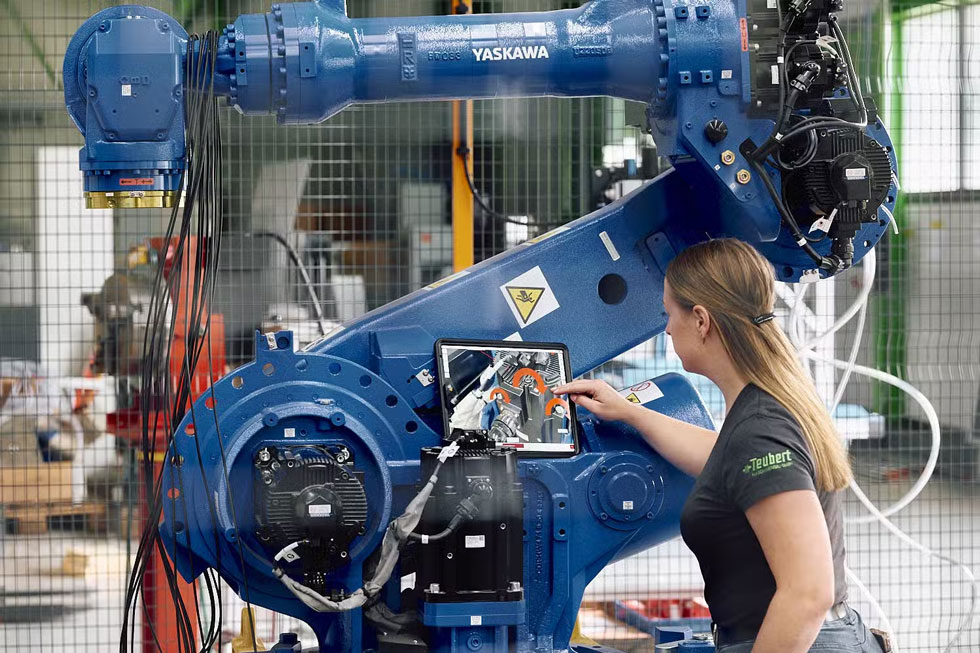
Organizationally, work processes, for example in the areas of service and maintenance, can be designed more efficiently and shortened. There is digital support for this in the form of work instructions that are immediately available to anyone carrying out maintenance.
If, for example, a machine needs to be serviced, the assigned person downloads the necessary instructions to their tablet or cell phone with a click. And can get to work immediately, without any further assistance.
Process optimization methods, from classic to agile
Depending on the goal of process optimization, there are a whole range of options that you can use to improve processes in your company.
We first distinguish between traditional methods of process improvement – such as Six Sigma or lean management – and agile methods that attempt to optimize processes independently of the hierarchy. These include methods such as open space or retrospectives.
Six Sigma
Six Sigma is a common method for reducing error rates (internal LINK to the text Reducing error rates, which is not yet online) in production processes, for example. The aim is to make production processes more efficient in the long term. The method is a continuous process analysis, i.e. it constantly checks whether existing processes can be further optimized.
Lean management
Lean management focuses on the reduction of waste. The name of the method can be appropriately translated as “lean management”, as the method was originally developed for use in corporate management. Today, lean management involves all stages of production. The entire value chain is analyzed and areas where waste occurs are identified. Then, within the framework of demand-oriented production, opportunities for improvement are continuously developed so that all processes run as smoothly as possible – thus avoiding wasting time and money.
The approach is based on a culture of continuous development and improvement. Well-known methods from lean management include Poka Yoke to prevent errors and the 5S method, which was developed to promote order and efficiency in the workplace in five steps.
However, continuous development also requires a constant overview of processes and making it easy for employees to participate in the improvement process by providing feedback, which requires digital tools that, in contrast to classic Office solutions based on Word or PowerPoint, enter into dialog with employees to record and analyze their feedback and working methods in order to initiate improvements.
Do you want to integrate process optimization into your company?
FMEA
The FMEA method also takes an analytical approach: It focuses on uncovering possible errors and attempts to identify and prevent as many errors as possible from the outset. A list of possible errors, error types and measures to avoid them is the basis of this method.
First steps
Process optimization begins with the big picture, a process analysis and definition of the processes. In order to initiate the improvement of processes, it must first be clear which processes exist, which have priority and where there is potential for improvement in these processes.
Select methods for process optimization
Step two would then be to search for suitable process optimization methods that best suit the planned improvements. There will certainly be several suitable variants with which you can implement the necessary process optimizations within your company. You should therefore look at as many methods as possible and compare the approaches and procedures with your own way of working: does the chosen model fit your business processes, your values and the way your company works? We call this phase redesign – this is where new approaches are formed in order to identify business processes and production workflows that are in need of improvement.
Then comes the implementation: you apply the process optimization methods derived from the analysis and redesign in the day-to-day operations of your organization or company.
Selection, analysis, optimization – and everything from the beginning
Combine different methods and continue the triad of analysis – selection – optimization. Even after the first step, the improvement of currently untapped potential, further opportunities will arise in the future. This is why process analysis is an ongoing task that will accompany your quality management. Because after implementation is before implementation: continued evaluation will always reveal processes in your company that are not yet running optimally.
Support with process optimization
Process optimization itself is a process in its own right, and it is ongoing. Every company works with a whole host of different processes that can be adapted again and again depending on external and internal requirements. As there are many methods for process optimization, it makes sense to start by comparing various methods for optimizing processes. Some people lose sight of the big picture – but that’s not necessary.
Products and offers for process optimization
Even if the costs can be off-putting at first: Many companies seek external support for process optimization. Whether in parts or as a comprehensive consulting package depends on their own needs and the size of the project. Such professional help is often useful for avoiding mistakes and for an efficient approach to process optimization itself.
Software as a helper for process management
There are many examples of process optimization software, and our application is one of the best. If you want to reduce errors in certain processes, if you need to distribute information quickly and in several languages, if a certain procedure needs to be explained to new employees more frequently: There is a suitable software for this, including the necessary consulting for the introduction of this tool.
Practical example: tepcon provides the tool for work instructions, worldwide
You have a roadmap for process improvement in your company or are at least already taking the first steps – wonderful. It is not always easy to find the right one for your own requirements among the many different options. An example of process improvement clearly explains how you can contribute to improving certain processes in your company in practice.
Work instructions via software
As specialists in digital support, we have many satisfied customers who have been able to improve the efficiency of processes with our help. Specifically, this involves the creation of work instructions that are needed again and again but may not be available to everyone at all times. We help out with digital work instructions that can be called up directly on site.
Service and regular maintenance are a matter of course in modern machinery. This work is carried out either by external contractors or by our own employees.
If all the necessary steps are recorded and documented digitally, this can lead to a significant reduction in the working time that staff have to spend on such services. We have selected a user example from our portfolio.
Do you want to integrate process optimization into your company?
Digital, multilingual work instructions for mechanical engineering
Our customers come from different industries, many of them from the mechanical and plant engineering sector. This includes the owner-managed company that designs and builds customized systems and machines – and to whom we provided valuable support with the tepcon instructor.
The customers and employees of this company operate worldwide, and in many languages. They need simple instructions that they can call up quickly and that are easy to understand. The team and customers often live in different time zones – simply calling the customer advisor to clarify a question is not a realistic option here. What is needed is prompt, direct support that is immediately available and self-explanatory. The best way to do this, of course, is in the customer’s own language, because technical details in particular need to be communicated clearly, but not everyone is always familiar with them in a foreign language.
Overcoming the boundaries of time and language with a digital specialist
With the tepcon instructor, we provide software that offers this help without any personnel costs. Employees of your company, their customers and business partners can share internal knowledge for specific processes around the clock, completely independent of time. At any time, with just a few clicks, on all available digital end devices.
Work instructions for completing certain steps, for example, are printed directly on the machine using a QR code. This means that someone who is not yet fully familiar with the processes can take another look online to see which step needs to be completed next. If required, the software translates digital instructions into numerous languages, which also prevents errors during the process.
Digital instructions make it possible: multilingual, comprehensive and intuitively understandable instructions are available for a wide range of processes anytime and anywhere. There is no need to contact customer service or a colleague to provide instructions. As a result, the tepcon instructor not only saves our mechanical engineering customers a great deal of time, but also costs for personnel who would otherwise have to be available to clarify open questions.
This practical example from the plant and mechanical engineering sector shows how the goals of process optimization can be achieved with the help of digital “specialists” in everyday life. And what part we play in this as a solution provider. The instructor increases the efficiency of existing processes and optimizes the workflow, measurably and verifiably in hard figures. And that across national and time boundaries. Please ask us for a detailed user report if you would like to know more!
Make an appointment for your initial consultation!
Do you have similar challenges for us? Make an appointment for a non-binding consultation and find out how we can optimize the workflow in your organization or company with our digital work instructions.