


Interval-based maintenance – maintenance with a system and plan
While manual and reactive maintenance still dominated almost all economic sectors until the 1970s, falling costs for measurement technology, sensor technology and IT subsequently led to new concepts. Initially, preventive approaches prevailed, followed by predictive strategies that characterize many maintenance management systems today.
Maintenance has become a key component of economic production, because the costs for it make up a relevant proportion of the total production costs.
Over time, various maintenance concepts have become established in the industry. Basically, they can be divided into three main types: corrective maintenance, preventive maintenance and predictive maintenance.
Interval-based maintenance is a form of preventive maintenance that is widespread and easy to control in many companies – it combines simple planning with high feasibility in production environments. We take a closer look at precisely this form of maintenance, its advantages and disadvantages and suitable maintenance measures in this knowledge article.
Definition: What is interval-based maintenance?
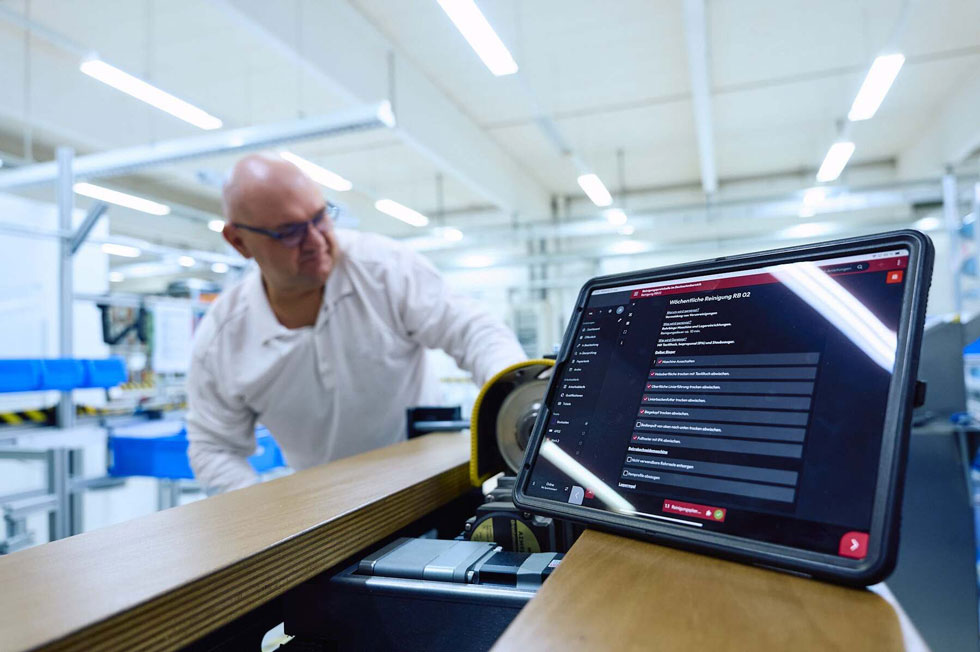
Interval-based maintenance (also known as time-based maintenance, or TBM for short) is a method of planning maintenance work based on a predefined schedule. Maintenance is carried out at defined intervals – e.g. in weeks, months, after operating hours or after a specified number of production cycles.
The intervals are typically derived from empirical values, manufacturer specifications or historical operating data. The aim is to prevent unplanned failures by replacing or testing parts and components in good time.
TBM is particularly suitable for systems where wear cannot be easily measured in real time or where continuous condition monitoring is not technically or economically feasible. Regular maintenance work is intended to extend the service life of machines and systems and reduce the number of unplanned downtimes.
Maintenance in accordance with DIN 31051 and DIN EN 13306
DIN 31051 defines maintenance as the entirety of all technical, administrative and organizational measures that serve to maintain or restore the target condition of an object during its entire life cycle.
An asset – in the sense of the standard – is any object that represents an economic or functional value for the company. This includes production machines, production lines, buildings, supply systems and technical infrastructures.
The main objective of maintenance in accordance with DIN 31051 is to ensure the availability, reliability and safety of a system over its entire service life. In addition, DIN EN 13306 describes maintenance in a European context and creates standardized terms and structures for maintenance management.
Predictive, preventive, interval-based – an overview of maintenance strategies
Predictive maintenance(preventive maintenance) includes all measures designed to prevent failures before they occur. It is divided into several strategies:
- Interval-dependent maintenance (time or usage-dependent): Maintenance is carried out according to fixed cycles – approximately every six months, after 1,000 operating hours or 100,000 production cycles.
- Condition-based maintenance (condition monitoring): The measures are based on the actual condition of the machine. Sensors monitor temperature, vibration or mileage.
- Predictive maintenance: Building on condition monitoring, data analysis and AI are used to predict the optimum maintenance time.
Conclusion: All interval-based maintenance is a form of preventive maintenance, but not all preventive maintenance is interval-based – it can also be condition-based or data-based.
Are you in a hurry? Click here to go directly to our product, the tepcon instructor!
Maintenance work on schedule – the advantages of TBM
Interval-based maintenance offers one thing above all: predictability. It creates clear structures for maintenance dates and resources and makes it possible to coordinate work processes in advance.
Advantages at a glance:
- High planning capability: Maintenance dates can be integrated into the production schedule in the long term.
- Reduced downtime: Regular maintenance work minimizes the risk of sudden malfunctions.
- Improved operational safety: systems are checked at defined intervals, which prevents accidents and downtime.
- Transparent costs: Fixed maintenance cycles make it easier to calculate budgets.
- Simplicity: Implementation does not require complex data systems or sensor technology.
This makes TBM particularly attractive for companies that want to organize their maintenance efficiently but pragmatically.
Interval-based vs. preventive maintenance – differences and similarities
Although both strategies serve the same goal – avoiding downtime – they differ in the basis of their planning.
- Interval-based maintenance is based on fixed time or usage intervals. It is standardized and easy to plan.
- Preventive maintenance in the broader sense also includes condition-based measures that are controlled by sensors or inspections.
Both approaches complement each other perfectly: while TBM is ideal for routine maintenance tasks, condition-based maintenance is suitable for complex systems with variable loads.
Challenges of interval-based maintenance
Despite its advantages, TBM also has some disadvantages and risks.
A central problem is the possibility of maintenance measures being carried out too early or unnecessarily. This not only increases costs, but can also cause new faults by interfering with functioning systems.
Typical challenges:
- Maintenance intervals that are too short: lead to increased maintenance costs (personnel, material) and potential early failures.
- Lack of data: Without precise empirical values, it is difficult to determine the optimum maintenance time.
- Planning effort: Coordination with production and external companies requires a great deal of organizational effort.
- Production interruptions: Maintenance windows disrupt ongoing operations.
- Loss of knowledge: Due to the preventive replacement of assemblies, there is a lack of experience regarding the actual failure behavior.
These challenges show that TBM must be carefully planned and documented in practice.
Book your personal demo and experience the benefits directly!
TBM measures – typical examples from the industry
There are numerous applications for interval-based maintenance in industrial production.
Examples:
- Lubrication and retightening of screw connections in mechanical systems.
- Replacement of filters, seals or oils in hydraulic systems.
- Calibration of measuring devices in testing and quality assurance processes.
- Inspection of safety equipment, emergency stop systems or sensors.
- Inspections of conveyor belts, bearings and gearboxes to prevent downtime.
These measures are carried out at regular intervals – regardless of whether actual wear is already apparent.
How to successfully introduce interval-based maintenance
The success of an interval-based maintenance strategy depends heavily on planning, organization and training.
- Maintenance planning and organization: The basis of every TBM is a precise maintenance plan that defines technical locations, intervals, activities, resources and target times.
- Coordination of maintenance windows: If possible, maintenance work should be carried out during periods of low production capacity utilization. Early planning minimizes conflicts with production and increases efficiency.
- Involvement of machine operators: Employees on site know the machines best. If they are actively involved in maintenance, the quality of the maintenance work increases.
- Training and qualification: Only qualified personnel can carry out maintenance tasks safely and efficiently. Regular training ensures know-how and reduces errors.
- Continuous improvement: Maintenance strategies should be regularly reviewed and adapted on the basis of new findings.
The “instructor” in preventive maintenance
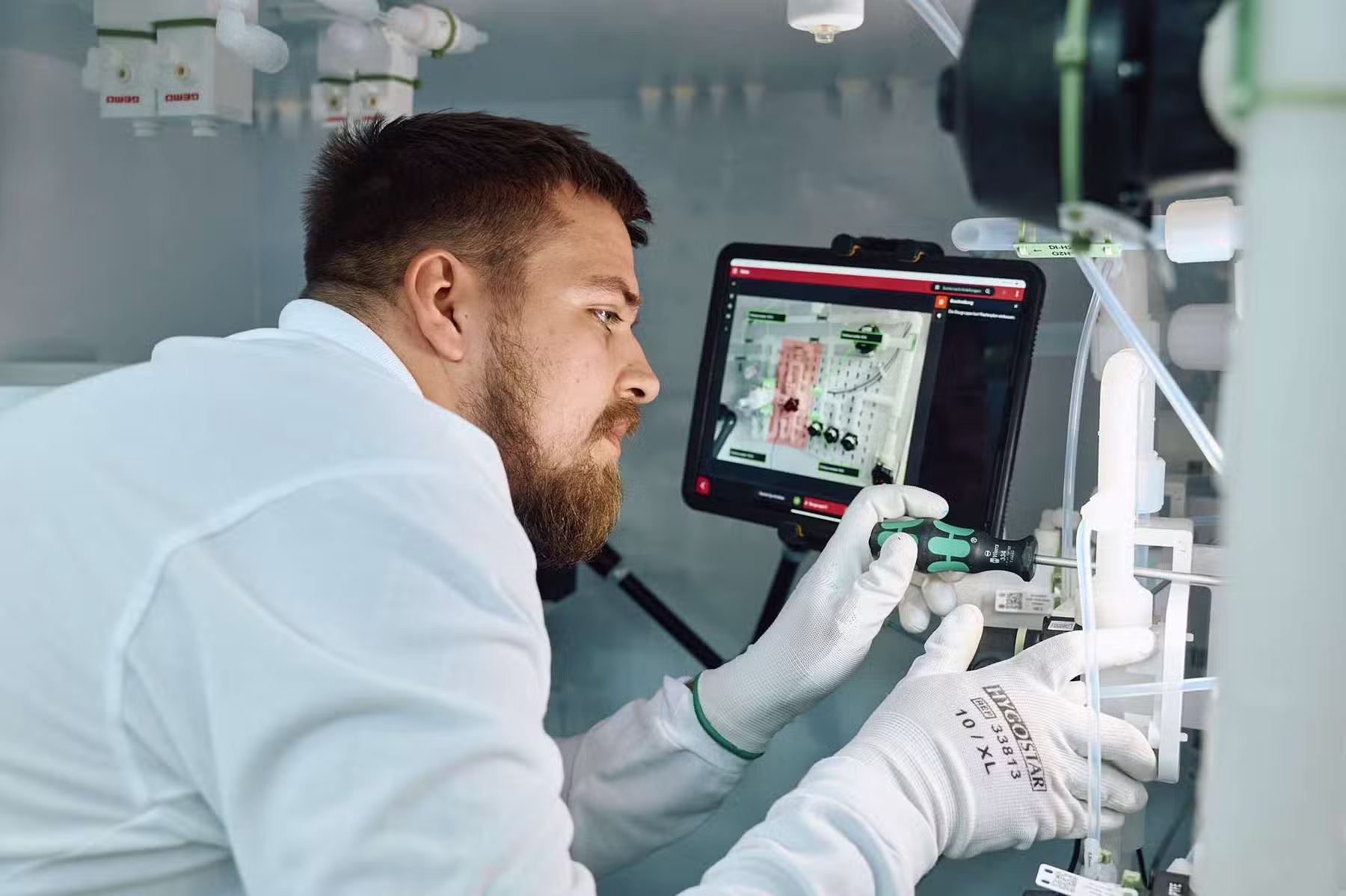
Our digital tool, the “instructor”, helps companies to implement their interval-based maintenance efficiently. With digital work instructions, integrated documentation and mobile support, technicians can follow maintenance tasks step by step – directly at the machine.
With the current release, we have also developed a calendar function for our “instructor” that can be used to plan one-off or recurring instructions – for maintenance or inspections, for example.
All maintenance is automatically documented, increasing transparency and traceability. Inspection instructions, checklists and safety information can also be stored. This creates standardized processes that significantly increase quality and efficiency in maintenance.
Maintenance and servicing digitally supported: we have solutions for your problems!
Interval-based maintenance remains a tried-and-tested method for operating systems reliably and predictably. It offers security, structure and transparency – especially when it is supported digitally.
With digital solutions such as tepcon’s “instructor”, maintenance work can be planned efficiently, carried out precisely and documented seamlessly. This creates a solid basis for quality management and continuous improvement in production.
tepcon is your partner for innovative maintenance concepts and digitalization solutions in industry and services. Since 2002, our goal has been to make technological change tangible for our customers.
Our “instructor” is your software for digital instructions and supports you in raising efficiency and safety in maintenance to a new level.