


Inhaltsübersicht
- 1 Optimization of your production with the worker assistance system
- 2 The most important facts at a glance
- 3 What are worker assistance systems?
- 4 Flexibility and adaptability
- 5 The tepcon “instructor
- 6 Training new employees: the instructor explains the assembly process
- 7 Using the instructor system successfully: our technology in use with customers
- 8 Communicate work instructions and information clearly: This is how tepcon revolutionizes your production!
- 9 Frequently asked questions
Optimization of your production with the worker assistance system
A worker assistance system provides digital instructions and feedback for industrial workers. It increases efficiency and quality, avoids errors and shortens the training period. Find out more about the benefits and use of worker assistance systems in this article.
The most important facts at a glance
- The worker assistance system supports workers with visual instructions and enables intuitive and efficient work in production.
- Such a system promotes error prevention, increases efficiency and reduces training time for new team members through clear, digital instructions.
- Flexibility and scalability are crucial in order to quickly adapt to new production requirements and ensure competitiveness.
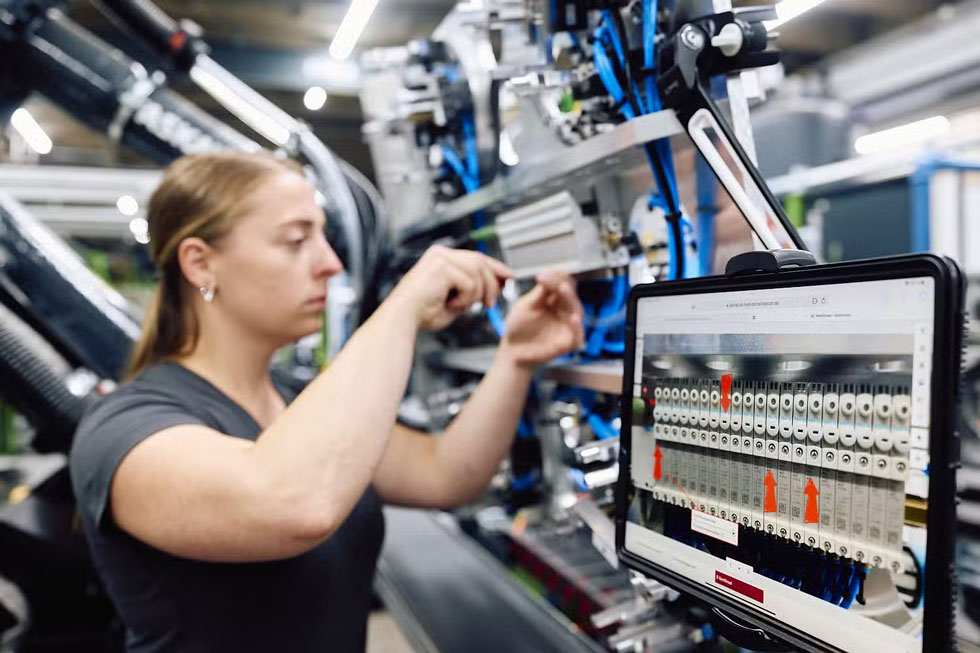
What are worker assistance systems?
Worker assistance systems are special software solutions developed to support workers in industry. These systems provide visual instructions for assembly workstations and guide both trained and less trained workers through processes at the workplace.
Assistance systems ensure that information is provided quickly and easily at any location. Specialists receive work instructions on digital end devices and the processes are explained in such a way that intuitive working is possible.
This not only saves time in the induction process, but also the use of personnel for guidance.
A worker assistance system can help prevent physical stress disorders with physical or technical support. It also speeds up decisions and the completion of tasks in production. This is particularly important at a time when quality and efficiency requirements are constantly increasing.
Worker assistance systems provide all the necessary information and data for any process digitally at any time, which makes work much easier.
In view of the increased demands, specific customer requirements and growing competition, digital worker assistance has become an indispensable component of modern production environments. The worker assistance system has long since formed the basis of efficient and safe production.
Advantages of the worker assistance system
A key advantage of worker assistance systems is the precise avoidance of errors. By providing clear and detailed instructions for each work step, worker assistance helps employees to carry out tasks without errors – and documents all work steps in the process. This leads to a considerable increase in efficiency and process optimization in the manufacturing industry.
In addition, employees benefit from a considerable reduction in workload, as they no longer have to search for information and data, but have everything available digitally. The speed of decision-making processes is increased through the use of digital work instructions, which leads to faster and more precise decisions.
The worker assistance system collects real-time data. This promotes transparency in workflows and supports well-founded decisions in each individual process. The tangible information from the worker assistance system ensures maximum transparency about the order situation and supports the distribution and safeguarding of knowledge within the company.
Switching to the worker assistance system can significantly reduce the amount of documentation required, for example by automatically creating work logs and lists of the data generated during the process.
Versatile information provision and interactivity
The core element and legal framework of quality management is the standard. More precisely, compliance with the standards and norms specified in the ISO 9000 series of standards. This international standard contains all the central specifications and principles of quality management that we use today.
ISO 9001 certified – the seal of quality management
Providing information
The employees receive real-time visual instructions through the production tasks; the work instructions are provided by the assistance systems in clear step-by-step instructions.
Give feedback
With the “Tickets” feature, workers can indicate or report back to the tepcon instructor when defects or missing parts occur. This message is then forwarded directly to the person responsible by email, for example. Disruptions in the production process, which can otherwise lead to chaos, can thus be avoided in advance.
This function contributes significantly to quality assurance and the reduction of rejects in production.
Instruct assembly
Monitoring
The interactive support in all work steps with instructions, graphics, information and documentation makes it possible: people work more efficiently and safely in this digital environment, which increases productivity and production quality.
Would you like to find out more about the worker assistance system?
Flexibility and adaptability
A key advantage of worker assistance systems is their flexibility. These systems are independent of specific hardware solutions and can be quickly adapted to changing requirements and new projects. This is an important strength compared to rigid inspection systems and enables a rapid response to changes in the production environment. As a result, they can cope with the wide variety of modern production systems in all areas.
The digital system compared with Pick by Light systems
Adaptable, flexible and efficient
This gives companies the flexibility they need to respond to customer requirements and market changes with a customized solution.
Modern worker assistance systems improve communication between employees and management, which leads to faster problem solving. The integration of sensors and cameras into these systems significantly increases process reliability and efficiency.
Wide range of applications
Worker assistance systems are used in various areas such as assembly, maintenance and quality inspection.
- Digital assistance systems support employees during assembly and maintenance by providing the information required for the work steps.
- They offer digital instructions that support both complex and simpler processes, procedures, machine operations, maintenance work and repairs.
- They facilitate quality assurance, for example by automatically documenting and logging every assembly.
- The use of artificial intelligence in quality assurance improves the analysis of error causes and the development of corrective measures.
- The worker assistance system enables new workers to be deployed quickly to different workstations, even in the event of sudden staff shortages.
- Checkpoints and checklists in the worker assistance system help to ensure the quality of the work steps.
Scalability and future orientation
Whether a worker assistance system, worker information system or worker guidance system, digital tools must above all be scalable, because the conditions of modern production are constantly changing and require constant adaptation.
A scalable system can be implemented quickly throughout the entire production process and adapted again and again.
A future-oriented worker assistance system should be able to adapt to new technologies and the requirements of Industry 4.0. The networking and integration of modern technologies into the production system ensures the long-term competitiveness and productivity of the company.

The tepcon “instructor
The tepcon “instructor” is an innovative example of a worker assistance system that revolutionizes the creation and use of digital work instructions.
- Step-by-step instructions are created directly at the workstation on the user-friendly interface, and new work instructions can be made available to all users immediately. This shortens the individual work steps and increases safety in assembly and production.
- Visual media, such as images and videos in the work instructions, help to explain each complex step.
- Instructions are called up via a QR code that is attached to products or machines. This shortens the search for the right instructions, reduces training times for new employees and minimizes downtimes.
- Using the “Tickets” function, workers can report back directly if there are problems or missing parts within processes.
The tepcon “instructor” offers a comprehensive solution for digital worker assistance in assembly and production. Companies that rely on this system benefit from improved productivity and higher quality in production.
Training new employees: the instructor explains the assembly process
Training new workers can be challenging, especially in complex production environments. Digital worker guidance helps them to learn new processes more quickly, which reduces training time. For example, you can use worker assistance systems to guide new fitters step by step through the assembly process – thereby shortening the training period.
The tepcon instructor’s instructions are easy to understand, so that even less experienced employees can follow them without any problems. This saves time and personnel resources.
An intuitive user interface also reduces the amount of training required for employees. This means that new tools can be used quickly and a new assembly process can be explained directly and without the need for personnel.
Would you like to find out more about the worker assistance system?
Using the instructor system successfully: our technology in use with customers
Our worker assistance system is now successful in many sectors: customers from the mechanical engineering and automotive industries, the construction industry and service providers use the tepcon instructor with measurable success.
The fact that the use of digital helpers, as a comprehensive worker information system or as digital work instructions for assembly, for example, is worthwhile has now also been scientifically proven in various case studies.
Our tepcon customers have their own positive experiences with the innovative and intuitive technology. Read more about these success stories in our user reports.
Do you want to know immediately whether our product is suitable for your business? Then get your consultation appointment now using our contact form.
Communicate work instructions and information clearly: This is how tepcon revolutionizes your production!
Wherever people have to complete a task, they usually need the right instructions. Whether it’s production processes in packaging, a maintenance procedure, a new task in production or in the IT area: workers often only need a few compact pieces of information to carry out the process successfully.
A person does not always have to provide the instructions. The tepcon instructor provides instructions and manuals with text and images, with clear graphics or as a 3D model.
For example, optimize cycle production in manufacturing, improve the workflow with simple and internationally usable instructions, in short: save time, money and personnel by keeping your workers up to date with the digital system.