


Efficient quality management: How you can reduce your error rate
In times of modern industrial plants, the assembly of new machines or extensions is standard. Time and again, investments are made and new equipment is purchased. This is not possible without precise information: installation instructions explain what the specialist personnel need to know before setting up a product or new machines.
Assembly instructions convey this information, for example, with step-by-step instructions, illustrations and diagrams. Assembly instructions also include a list of the tools and materials required. Finally, the instructions also contain the necessary safety instructions and precautions for handling the item or appliance.
Quick overview of instructions
As the different types of instructions are often used synonymously or sometimes confused, here is a brief overview of the most common instructions – all of which you can easily create with the tepcon instructor:
- Assembly instructions
- Operating instructions or operating manual
- Installation instructions
- Maintenance instructions
- Service instructions
The installation instructions help you through the first steps in the life cycle of a product or machine. Only when proper assembly has been completed does step two follow: the operating instructions may now explain how to commission and use the appliance.
Depending on the device, the installation instructions may need to be consulted first: They provide information on how to install a product correctly at its destination. Technicians and specialist personnel may find information here about connection requirements (e.g. electricity, water, data lines) and the location requirements of the device.
The digital assembly instructions
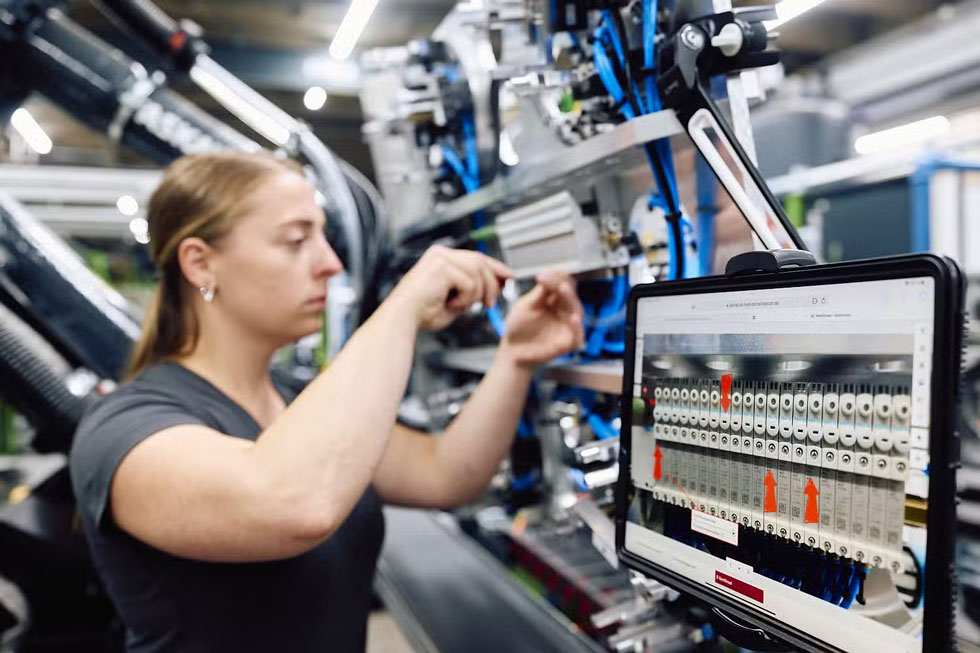
Whereas in the past thick manuals had to be pored over or a text on paper, often in a huge format, had to be laboriously unfolded, the assembly instructions for all requirements are now fortunately available digitally.
Let’s take a closer look at assembly instructions: What forms are still used today, what legal basis is needed for standard-compliant instructions, how can you create assembly instructions for your company yourself?
If you are looking for a digital solution for assembly instructions, but also for operating instructions, installation instructions and technical documentation, we can tell you right away: You’ve come to the right website. You can address specific inquiries directly to our customer service.
Types of assembly instructions
Assembly instructions are indispensable tools in modern industry that help fitters and technicians to install machines and devices correctly and safely. The term assembly instructions is often used synonymously with operating instructions, even though assembly actually only refers to the first step: assembly instructions contain the information you need to set up an item, device or machine in the first place.
Assembly instructions are available in various formats and media, each of which has its own advantages and applications. The most important types of assembly instructions are presented below, the legal framework is discussed and a guide to creating such instructions is provided.
Installation instructions on paper
Installation instructions provide detailed steps for setting up a product. They usually explain by text and include illustrations for a better understanding.
Such instructions have long been the standard way to ensure that incomplete machines and systems are installed correctly and function safely.
However, the paper format of the instructions involves a certain amount of extra work and no longer meets all customer requirements for this product. In addition, information in text and images cannot be updated here if, for example, there are new editions of a product.
The printing costs for such a document must also be taken into account.
Video instructions
However, video instructions also have some disadvantages: If the product changes, updates are usually not possible and new video instructions have to be created straight away.
Depending on the target group, the content can also be better conveyed using other forms of instructions. Last but not least, just like paper-based instructions, videos are not suitable for technical documentation.
Modular assembly instructions
Instructions for use
Like the assembly instructions, these instructions are also available on paper, as a digital tool, in 3D or as video instructions.
3D animation
Suitable software for creating 3D instructions often also includes the necessary functions for technical documentation.
Augmented reality guide
This can significantly increase precision and efficiency during assembly. In addition, such assembly instructions can be used to work independently, for example, fewer personnel are required as customers are automatically guided through this type of operating instructions.
Quick Start Guide
A Quick Start Guide is a simplified operating manual that describes the basic steps for commissioning a product. This guide is ideal for users who want to get started quickly with a product without delving deep into complex technical details. However, it is no substitute for comprehensive installation instructions.
The legal framework: Requirements for the assembly instructions
In industry, assembly instructions must comply with certain legal requirements.
One of the most important is the Machinery Directive 2006/42/EC of the European Union. This directive stipulates that machines and their operating instructions must be safe and that the assembly and operating instructions must be available in the language of the end user. If a product is sold on the European market, multilingual assembly instructions may therefore also be required.
The Machinery Directive also requires that the instructions are clear and comprehensible and contain all the necessary information on safety and maintenance.
Would you like individual and innovative assembly instructions?
Creation of assembly instructions in four steps
Assembly instructions can be created in-house. Companies often do this themselves, especially if a technical writer is part of the team.
To ensure that the creation of your assembly instructions runs smoothly, here is a brief overview of the most important steps to follow.
Analysis and planning
It is important to take the Machinery Directive and other relevant regulations into account.
Creation of the content
The use of images, diagrams and videos makes complex information easier to understand. Also make sure you use target group-specific language so that the information you want to convey is also understood by the people who install the device.
Layout and design
A clear structure, legible fonts and consistent formatting are important. The use of symbols and color coding can also increase the comprehensibility of assembly or operating instructions.
Testing and updating
Also bear in mind that the instructions may need to be updated if there are changes to the product or regulations. If it is already clear in advance that content or parts of the assembly instructions need to be updated, a digital tool with suitable specifications is recommended.
Digital solutions for assembly in the age of Industry 4.0: the “tepcon instructor”
In the age of Industry 4.0, digital solutions for assembly instructions are becoming increasingly important. Data is being updated faster and faster, documentation is becoming more comprehensive and efficiency no longer depends solely on the expertise of employees, but above all on how quickly and to what extent new information can be retrieved.
Today, manufacturers and producers need suitable digital tools to provide the necessary information for installation and commissioning. The industrial environment in particular, with its rapid technological progress, makes updates to every system, software or individual device necessary time and time again.
The effort involved should remain as manageable as possible, both in the creation of the assembly instructions and in their implementation.
As we have seen, designing and formulating assembly instructions is quite a demanding project. The requirements are extensive, both in terms of content and in terms of personnel costs.
Not every company can or wants to make such an effort. However, if you need professional guidance for your product, our software tool is the right choice.
Customers from a wide range of industries are already benefiting from our “instructor”, which saves them time, money and nerves compared to conventional templates.
Especially in mechanical engineering, where documentation and process optimization play an important role in all areas, we have numerous regular customers who are convinced by our “instructor”.
But other industries also rely on the ultimate tool for assembly instructions, such as companies in the construction and service sectors.

Assembly instructions for your machines in minutes: Software process optimization with the tepcon “instructor”
Our tepcon” instructor” is an outstanding software solution in the field of assembly instructions. This process optimization software enables companies to create and manage digital instructions easily and efficiently, without major technical or time expenditure.
The advantages of a tepcon “instructor”
The tepcon “instructor” offers numerous advantages that help companies to optimize their processes. The user-friendly interface and intuitive operability make the software easy and effective to use.
The solution is cross-platform, which means that it works on PCs, tablets and smartphones.
Within minutes, you can create assembly or operating instructions for any machine, incorporate updates or update the table of contents.
Your employees have access to all information just as quickly, directly at the machine, via the website or using a QR code that can be easily created with the tool.
This increases the flexibility and availability of the instructions.
Special features include the option of versioning and change tracking, which improves transparency and quality control.
The cloud-based structure allows access to instructions from anywhere, and the integration of single sign-on facilitates access.
Would you like individual and innovative assembly instructions?
3D models and more: the features
The “tepcon instructor” brings immense benefits, such as increasing quality and productivity and securing know-how.
Logging the work steps helps to minimize errors and continuously improve processes. The actual implementation of the instructions is observed and monitored, and the results can be integrated directly into existing processes.
The ability to offer instructions in different languages supports international teams and customers.
The software is also easy to implement and requires minimal training.
With the create/recorder mode, you can record instructions directly on the object, including images, videos and documents. You can also easily integrate 3D models on all topics here.
All instructions can then be easily accessed with a mobile device via QR codes.
Technical documentation requirements can be handled almost incidentally with the “instructor” because the tool documents every step on request and thus makes it traceable.
We also support the implementation of the “instructors” with comprehensive training on request and provide tips for optimal use by users.
Get to know the tepcon “instructor”!
Today, no machine or product can do without assembly instructions. Their information is essential for the correct and safe installation and subsequent use of machines and devices.
The variety of formats, from traditional installation instructions to innovative augmented reality instructions, shows the range of options available to companies.
However, digital solutions such as the “tepcon instructor” clearly stand out in the context of Industry 4.0. They not only offer efficiency gains and quality improvements, but also a future-proof solution that meets the increasing demands for flexibility and availability.
Companies that invest in such technologies can gain a competitive edge and strengthen their market position in the long term.
Do you have any questions or need more information? We will be happy to make you an individual offer. Ask for our demonstration or read more on our website about manufacturers and customers in the sectors for which we have already implemented successful projects.
Or you can contact our team directly: We will be happy to answer any questions you may have about assembly instructions with the “instructor”.