


Shopfloor Management SFM: structured problem solving at the point of value creation
At the heart of modern production is a consistent focus on efficiency, quality and continuous improvement. Shopfloor Management SFM provides an effective framework for this: Problems can be solved where they arise, namely in the production hall itself.
As a software provider for digital work instructions, we know how crucial transparent and structured process control is for the success of a company. Digital store floor management gives you more control, more clarity – and plenty of potential for improvement.
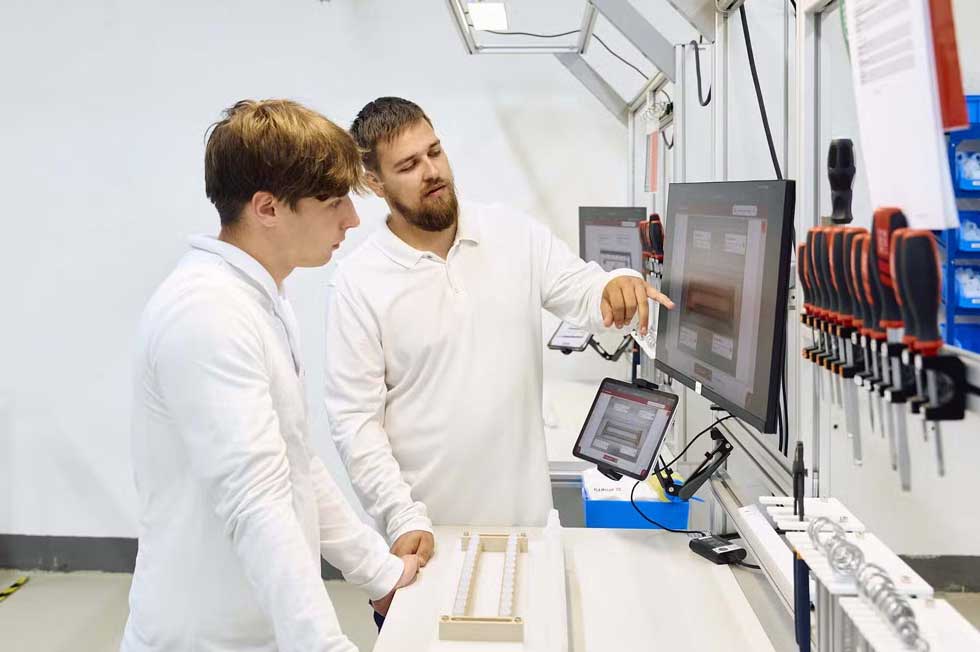
Shopfloor Management Definition
Store floor management describes a form of management in which managers perform their tasks directly on the store floor. It is a central component of modern management and leadership tasks in industrial production.
The focus is on structured problem solving, the continuous improvement of processes and direct cooperation with employees. Store floor management is based on regular communication, visual management, clear key figures and the constant presence of the manager at the place where value is created. Employees are actively involved in decisions and are responsible for achieving targets.
Methods and objectives of store floor management
The objectives of store floor management are clearly defined: Processes should be stabilized, problems quickly identified and improvements sustainably implemented. This is achieved through standardized methods such as
- Regular store floor meetings: short, daily meetings between managers and employees directly at the workplace.
- Visual management: transparent presentation of key figures, tasks and deviations for quick orientation.
- Standardized work instructions: clear guidelines that are always up-to-date and available thanks to digital solutions.
- CIP workshops: All employees work together on structured improvement processes.
Managers lead on site and ensure that management and control tasks are effectively linked with implementation by employees. The continuous exchange creates trust, motivation and a focus on common goals.
Challenges
Despite the clear advantages, the introduction of store floor management also brings with it some challenges.
For example, the question of how existing structures and habits can be changed without generating resistance from employees or managers. There is often a lack of clearly defined management tasks or the necessary time to be regularly present in production.
The implementation of “leading on site” requires a new attitude in management and a willingness to deal directly with processes and problems on the shop floor on a daily basis.
Another challenge is to introduce the right elements of store floor management in a targeted manner and to link these with the existing processes. Particularly in companies with many different production areas, control must be coordinated across the board so that the measures for structured problem solving actually take effect.
Visual management for everyone in the team
It is also important to design the visual management in a meaningful way – comprehensible, up-to-date and practical, so that all employees see real added value in the new transparency. A sure instinct is required here in order to promote trusting cooperation and an open communication culture.
Only in this way can shopfloor management develop its full effect.
This is exactly where digitalization comes in: It creates new opportunities to significantly improve overview and efficiency on the store floor – while at the same time reducing complexity.
The increasingly complex processes within a project are discussed daily or even weekly in store floor meetings and measures are defined to resolve problems or introduce improvements.
Digital solutions are then available for constructive problem solving: if there are more assembly instructions, work instructions or test instructions for the activities in the project, the basis is laid for rapid intervention and correction.
Let’s take a closer look at how modern tools help to control processes transparently and provide targeted support for management tasks in production.
Are you in a hurry? Click here to go directly to our product, the tepcon instructor!
More overview at the point of action thanks to digitalization: important tools for store floor management
More and more companies are turning to digital solutions in store floor management to meet the increasing demands in production.
Digitalization opens up new opportunities to make complex processes clearer and at the same time provide more targeted support for management tasks. On the production floor in particular, it is crucial that relevant information is available in real time – transparent, comprehensible and accessible to everyone involved.
Digital tools help here: the aim is effective control rather than the mere presence of managers on the store floor. With well thought-out tools, deviations, bottlenecks or problems in the production processes can be identified at an early stage and addressed directly.
Modern systems automatically record key figures, present tasks clearly step by step and systematically document solutions to problems.
This not only takes the pressure off managers, but also strengthens employees’ personal responsibility.
Interactive dashboards, mobile applications and networked systems ensure clarity – regardless of location. Progress, open issues or necessary measures are visible at a glance. This makes it possible to consistently pursue the goals of store floor management and at the same time improve communication between teams, departments and hierarchical levels.
Store floor boards are a key element in ensuring that a continuous improvement process is successful – and digital work instructions are also becoming increasingly important here.
How can these two tools together become a powerful instrument for management and continuous improvement? We will be happy to advise you personally.
Store floor boards and digital work instructions
In its traditional form, the store floor board can be found as a board or notice board in store floor management. This is where employees get all the information they need at first hand.
In times of advancing digitalization, the introduction of appropriate tools is urgently required: Their advantages, such as access to data and information in a matter of seconds or fast communication, mean that software tools are now generally used as store floor management boards.
Digital shopfloor boards are increasingly developing into central platforms for daily management directly in production. They combine various aspects of shopfloor management in one place – from current key figures and task tracking to structured problem solving.
Managers can view information in real time, consult with teams and identify potential for improvement together with employees. This not only promotes transparency in production, but also the personal responsibility of each individual.
Digital store floor boards are particularly effective in combination with digital work instructions, test instructions and protocols.
Instead of printed documents, which are often outdated or confusing, employees have access to modern, visually prepared and context-related instructions – directly on tablets, displays or mobile devices on the store floor.
This digital form of information provision is not only faster and more error-free, it also offers the possibility of supporting complex processes with images, videos or interactive elements. This helps to carry out processes cleanly, avoid errors and ensure sustainable quality.
At the same time, improvements can be integrated directly into ongoing operations. Changes to processes, new standards or optimized process steps can be entered with just a few clicks and communicated directly – without media disruptions or loss of information.
This provides managers with a powerful tool that enables them to perform their management tasks efficiently while remaining close to the challenges of day-to-day work.
Last but not least, digital work instructions strengthen collaboration between departments. Every employee knows what needs to be done at all times and can access up-to-date information when needed. This reduces queries, increases productivity and ensures greater security when dealing with varying requirements.
This makes store floor management, equipped with precise digital instructions as a basis, a real success factor for companies that want to remain competitive in a dynamic manufacturing environment.
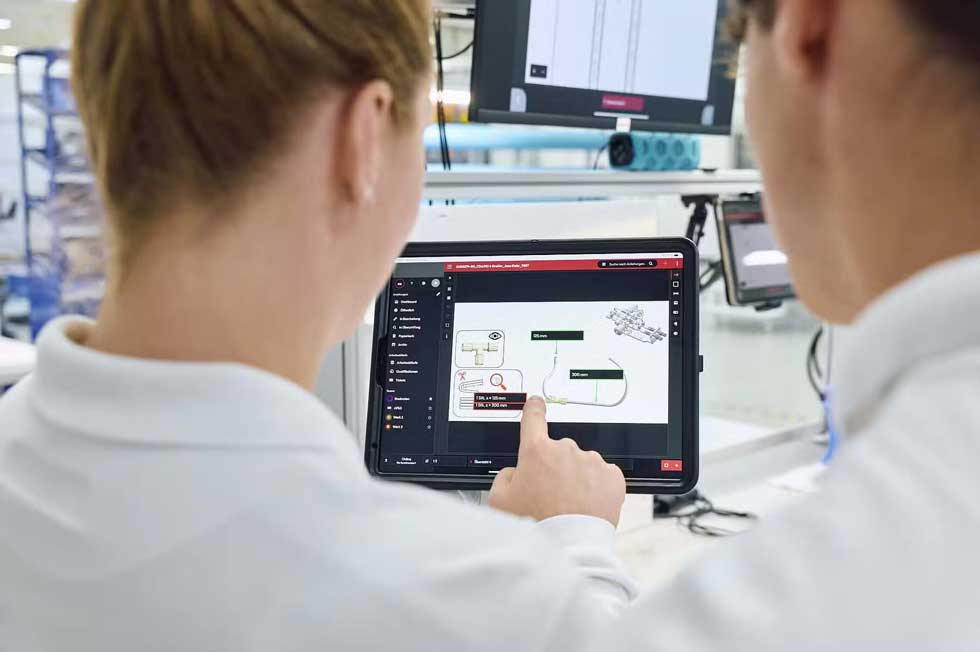
Shopfloor management with the tepcon “instructor”: Details made easy
Worker guidance, work instructions, precise service documentation and assembly instructions that can be accessed at any time are worth hard cash on the store floor. Digital software solutions that provide these services are ideal for comprehensive store floor management.
Managing a wide variety of tasks in industrial production poses considerable challenges for company management: A lot is constantly changing in production. This means that a sustainable and structured solution to problems that is accessible to employees and managers at all times must be flexible, easy to adapt and self-explanatory.
As a provider of innovative digitization solutions, we are there for you: Our solution is called “instructor”.
The sophisticated software offers your company all the functions it needs to create instructions, workflows and orders within minutes, it is multilingual and available for a wide range of interfaces – even store floor management can be connected in this way.
Visual management supports employees with videos, 3D content and PDFs that are child’s play to enter. Logs, checklists and suggestions for improvement, including complete documentation, are available at any time with just a few clicks.
And in the event of a fault, the ticket system supports the workers: with individually customizable ticket templates and documentation of all measures relating to any faults.
This is just one of the functions offered by the tepcon “instructor” to support store floor management.
You can find all the details here – or directly from our personal contacts.
FAQ Shopfloor Management
What is store floor management?
The method aims to make processes transparent, identify problems quickly and solve them together with employees on site.
This enables continuous improvement of work processes, greater efficiency and higher product quality.
What are the core elements of store floor management?
The most important core elements of store floor management are:
- Leadership at the point of action – managers are regularly on the store floor.
- Create transparency – with visual aids such as key figure boards.
- Regular communication – structured short meetings directly at the workplace.
- Strengthen problem-solving skills – employees are involved in finding solutions.
- Continuous improvement (CIP) – systematic optimization of processes.
What is a store floor board?
It serves as a communication and management tool at daily team or shift meetings and helps to quickly identify deviations and any need for action.
What does store floor management have to do with lean management?
Both management approaches aim to avoid waste and promote the continuous improvement process. With store floor management, managers are present directly on the store floor – in the workshop, the production hall, the laboratory – where they can identify problems at an early stage and develop sustainable solutions together with employees.
Managers take on an active role by observing processes, involving employees and providing targeted leadership.
The basic idea behind store floor management: the direct location of production becomes the central platform for communication, control and improvement. Elements such as visual management tools, short rule communication and daily coordination help to increase transparency and boost efficiency.
Shopfloor management brings lean management to the place where value is actually created – creating a cultural change in companies in which managers and employees take joint responsibility for processes and results.
How does store floor management support managers and employees in day-to-day production?
Store floor management provides managers with an effective tool to carry out their tasks in a transparent, comprehensible and targeted manner. At the same time, employees are involved in their responsibilities, which not only boosts motivation but also promotes process improvement.
The method thus ensures greater clarity, better coordination along the value chain and greater success for the company in the long term.
What are the advantages and disadvantages of shopfloor management for companies?
The method strengthens communication between managers and employees and thus optimizes the continuous improvement process. Companies that follow the lean approach in particular use store floor management as a central management tool for controlling key figures, processes and behaviors.
One of the disadvantages is the effort involved in the introduction. Leadership and management must be prepared to change routines and increase their own presence on the store floor. Without a clear definition of responsibilities or a lack of consistency in implementation, the desired benefits may not materialize.
In addition, training is needed to sustainably educate managers and employees in the components and objectives of SFM. However, when applied correctly, the benefits clearly outweigh the disadvantages.
What is the difference between store floor management and other management methods?
Another difference lies in the application of the lean approach: store floor management does not pursue a purely reactive management style, but a proactive one. Problems are not managed, but solved together with the employees.
Regular meetings and defined key figures turn pure control into a system of continuous improvement. This combination of proximity, method and attitude makes SFM an indispensable part of modern production management.