


Worker self-inspection made easy
With “instructor”, tepcon GmbH from Donaueschingen has launched a software solution on the market that enables companies to let their employees work almost independently. Queries and unnecessary paper documentation are now a thing of the past.
Worker self-inspection: the tool for more quality in industrial production
Worker self-checking, also known as worker self-inspection, is an important process in industrial production. It describes the systematic inspection of workpieces by the employees themselves, directly during or immediately after processing. The aim is to detect defects and deviations from defined quality standards at an early stage and to rectify them immediately.

Why worker self-inspection is important
Early identification of findings
One of the biggest advantages of worker self-inspection is the early detection of errors and deviations. Errors that are only discovered in later production steps or during the final inspection can result in high costs.
Deviations are detected at an early stage by means of the worker self-check.
Error avoidance
Worker self-monitoring goes beyond mere error detection. It helps to prevent errors directly by directing employees’ focus on quality standards.
Workers thus develop a better understanding of the importance of each individual work step and the effects of deviations on the end product. Manufacturing companies that rely on worker self-checks sustainably reduce the error rate and improve product quality.
Team motivation: take your employees with you!
Another crucial aspect of worker self-monitoring is the involvement of employees in the responsibility for quality.
If they are actively involved in the quality inspection process, their motivation increases. The awareness of having a direct influence on product quality strengthens team spirit and leads to a positive working atmosphere.
However, a prerequisite for this is that the company supports the workers with training and clear instructions. A good introduction to worker self-assessment promotes commitment and ensures successful implementation in the long term and from the outset.
Would you like to find out what the tepcon instructor can do for you? Click here for a free initial consultation!
Would you like to find out more about worker self-testing?
This is how quality assurance works: important questions in the factory self-assessment
Ensure quality control, transparency, quality checks
Quality control must be an integral part of every work process for worker self-inspection to be fully effective. Transparency is essential here: employees must know exactly which quality standards apply, which inspections they are to carry out and where which documentation is to be completed.
Quality checks can be standardized using checklists and clear specifications.
In this way, employees do not overlook any details. The result: all workpieces consistently meet high quality requirements.
Complexity of processes: clear documentation
Complex production processes require clear documentation. A clear and comprehensible structure for worker self-inspection makes it easier for employees to carry out the necessary inspections and document them at the same time. This means that deviations do not go unnoticed for long.
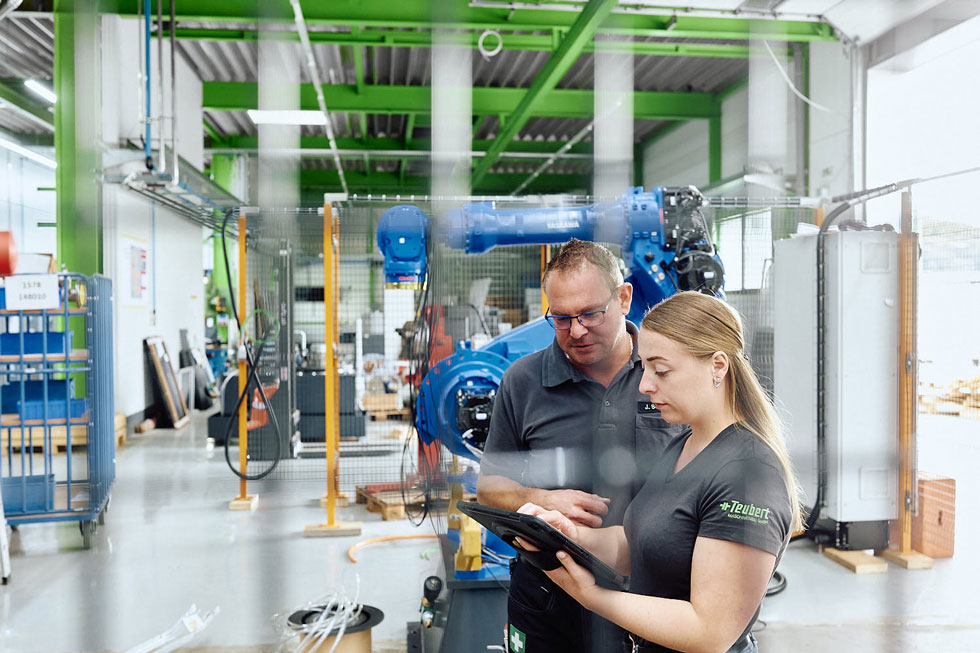
Tips for self-auditing: from the efficiency and improvement of your quality control
Do you want to improve your quality control along the production line and are looking at how to establish modern worker self-inspection in your own company? Then we have some important tips to get you started.
Plan the introduction carefully
Start with a carefully planned introduction of worker self-inspection. Communicate the importance of this process to employees and ensure that they have the necessary tools and knowledge.
Use checklists
Checklists are an indispensable tool for standardizing an inspection. They help workers to consistently check the quality of each workpiece.
Regular training courses
One of the prerequisites for a functioning worker self-inspection is the continuous training of employees. It is necessary that they know the current quality standards and inspection requirements, not only at the beginning of the process, but also on an ongoing basis after you have established the worker self-inspection.
Feedback and optimization
Provide employees with regular feedback on their work and the effectiveness of the worker self-assessment. Collect suggestions for optimizing the inspection processes and implement them.
Integration of modern technologies
Use digital tools to document every test and evaluate the results. This facilitates tracking and contributes to the long-term improvement of product quality.
Digital worker self-inspection, checklists and inspection documentation always on site
The sector in which your company operates is of secondary importance. Every company that deploys employees in the production process or provides services is faced with the task of instructing these employees. Worker self-assessment is also extremely important.
Traditionally, work instructions, test instructions or various checklists are used for this. Creating these is often quite time-consuming. On the one hand, they should be clear and easy to understand, but on the other hand they must also cover all eventualities. If instructions are not clearly formulated, there will be queries. This costs everyone involved time and interrupts the process until the open questions are answered.
The solution from tepcon
tepcon has developed the instructor a software solution that reduces this effort and makes processes much more effective and streamlined. Work instructions, test instructions, audit checklists and the like can be created, adapted or expanded in a matter of minutes.
This gives us the ideal solution for modern quality assurance in production: a tool that not only imparts knowledge, but also supports quality control in the form of individual worker self-inspection.
Would you like to find out more about worker self-testing?
Quality assurance 4.0: a user-friendly tool for worker self-inspection
The developers of the instructor always focused on one thing: making the application as simple and clear as possible for the user, i.e. the worker. Our solution to this issue: equipping instructions with machine-readable codes, such as QR or barcodes. These codes, attached directly to the system, allow access to all necessary documents or instructions at any time.
Worker self-testing in many languages
The codes are not only easy to scan, but can also be translated into up to 133 languages with just one click. This ensures that even foreign-language employees can understand technical content and implement it in the process.
Explain and accompany the test via video, document results
In order to record unforeseen events in the process, the software allows the worker to add videos or photos and thus document the actual process sequence. This not only ensures traceability, but also saves the worker carrying out the work from having to go to the supervisor.
All quality data documentation is digitized and can be accessed worldwide in the cloud using a computer, tablet or smartphone.
Self-testing 4.0: uncomplicated, independent, efficient
With the instructor, worker self-checks finally find their reference to the term “self” and significantly relieve organizations of unnecessary control tasks.
The tepcon instructor opens up the potential for our customers to make processes more effective, simpler and more comprehensible and to dispense with paper instructions. The user interface of the instructor interface is easy for users to operate and can be taught with minimal training.
Do you have any questions on this topic? Are you looking for case studies? Get in touch with us here, we look forward to hearing from you.
FAQ Factory self-inspection
What are the advantages of worker self-assessment for my company?
Worker self-inspection offers numerous advantages for your company:
- Error reduction: The early detection and elimination of possible errors directly during the execution of tasks increases quality.
- Less rework and rejects: Early action prevents unnecessary rework and significantly reduces rejects.
- Fewer complaints: Higher quality products lead to fewer complaints, which saves both costs and time.
- Promoting personal responsibility: Employees take on more personal responsibility for their tasks, increasing motivation within the team.
- Optimized processes: With the help of clear templates, checklists and forms, the performance of audits is standardized and made more transparent.
How does the tepcon instructor support worker self-testing?
The tepcon instructor offers an innovative solution to make worker self-inspection more efficient and less labor-intensive
- Digital checklists and templates: The instructor provides structured, customizable templates that make it easy and precise to carry out the tests.
- More efficient recording and logging of measurements: With digitized procedures and tools, measurements can be recorded faster and more accurately.
- Support for managers: Every manager involved can receive detailed reports and analyses.
- Reduction of errors: The clear structure and intuitive operation minimize errors during testing.
- Staff optimization: With the tepcon instructor, tests can be carried out reliably even with low staffing levels.
In what form does your software support worker self-inspection?
Instead of getting bogged down in paper-based checklists, you benefit from intuitive operation on a tablet or terminal, seamless traceability and direct links to quality and production data.
The result: fewer errors, shorter throughput times and significantly higher process reliability in production.
How does the tepcon "instructor" digitize worker self-testing compared to traditional paper processes?
This saves you time in documentation and increases transparency for everyone involved.
What functions does your software offer for multilingual worker self-checks?
This function minimizes errors, simplifies the training of new employees and ensures uniform quality assurance throughout the entire production process – regardless of who speaks which language. In addition, language versions can be maintained centrally so that changes are immediately available to all users.
Can tepcon "instructor" integrate worker self-inspection into existing MES or ERP systems?
This means that all employees are always kept up to date and the required data is recorded efficiently and accurately – without any superfluous information or mountains of paperwork.
How quickly can the "instructor" be introduced?
Training courses for employees and administrators are easy to integrate and existing checklists can be imported directly. Thanks to the intuitive user interface and centralized maintenance of inspection plans, you can quickly switch from paper-based processes to digital workflows and immediately benefit from seamless documentation, greater efficiency and improved process reliability.
Do you have any questions about implementation? Just get in touch and we’ll help you straightforwardly.