


Paperless production: The best strategies for digitizing production
The days of routing slips, handwritten lists and printed Excel spreadsheets are over – or so you would think. The digitalized world of work in industry relies on paperless production, but the possibilities of this development have not yet arrived everywhere in practice.
Paperless manufacturing transforms traditional, paper-based production processes into fully digital workflows. In the following article, we explain how this works, what the advantages of paperless production are and how you can upgrade your production processes with digital tools.
The most important facts at a glance
- Where paper-based processes are replaced by digital workflows, we save costs and increase efficiency.
- The implementation of suitable tools in production requires a thorough analysis of existing processes, the development of individual solution concepts and the careful selection of suitable software solutions.
- Challenges such as cultural resistance and integration complexity can be overcome with comprehensive training and clear communication.
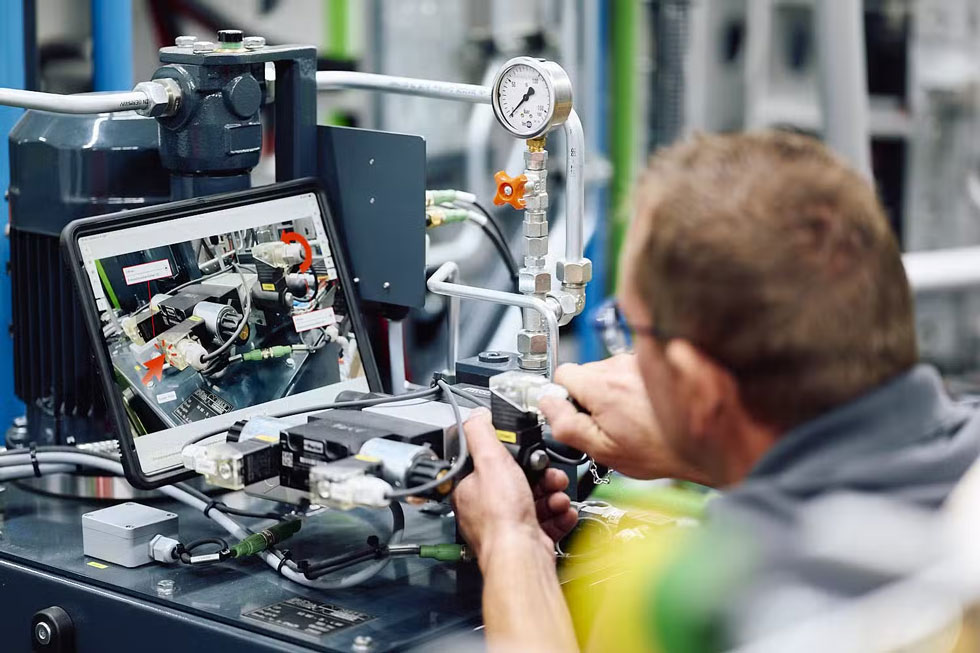
What is paperless manufacturing?
The term refers to the transition from the well-known “paper economy”, the printed or even handwritten paper, to the purely digital recording of data in practice.
This covers all aspects of production, including data capture and communication. Where digital systems such as ERP and MES are used, physical documents, i.e. good old paper, are no longer necessary and are not very efficient.
Transparency also suffers from files and mountains of printouts, lists and slips of paper.
The industry has long since learned that paper-based production is inefficient and not sustainable. Transferring knowledge, forwarding communication, collecting data, making information available – all of this works faster with a digital connection than on paper.
Digitalization enables real-time updates and the display of production data, for example, which leads to better production control.
The smart factory is revolutionizing manufacturing processes: Advantages of paperless manufacturing
The factory of the future is a smart factory: it works digitally, right down to the last corner of production. One of the building blocks of this future-proof factory is the conversion of production to working entirely without pen and paper.
The advantages of paperless production are manifold and affect almost every aspect of production.
Increased efficiency
Companies that have switched to paperless production report significant increases in efficiency and lower error rates. Digital tools optimize production processes and enable changes in real time. In the automotive industry, for example, information is available at all times and is recorded using digital documentation. This speeds up production processes considerably and therefore shortens the overall production time.
Comprehensively networked and automated production processes allow significantly higher reaction speeds, for example in the event of production changes.
Real-time transparency and optimized workflows are decisive factors for increasing efficiency.
Cost reduction
The use of paper in production is increasingly being reconsidered, because time is money. And this is where savings can be made in paperless production. Paper-based processes often lead to long waiting times, a lack of transparency and a loss of quality, which makes companies inefficient.
By delivering documents digitally with proof of delivery and 2-factor authentication, companies can avoid printing and postage costs, for example.
Shorter information paths via the information superhighway and the availability of documents regardless of time and place can significantly improve the use of resources.
Error reduction
Digital systems eliminate common sources of error, as information no longer has to be processed manually. This is not only faster, but also avoids all-too-human errors, for example in data entry. The error rate decreases and efficiency increases as a result.
The increased transparency and traceability of processes also helps to reduce errors. These improvements ultimately lead to better quality assurance and customer satisfaction.
Are you in a hurry? Click here to go directly to our product, the tepcon instructor!
Implementation of paperless production
If manufacturers want to switch to digital solutions, they not only need the necessary information about the possibilities. Above all, the topic must be implemented in the company in such a way that the benefits of paperless production can actually be fully exploited. This requires a certain amount of planning.
Despite the technologies available, the actual implementation can be challenging and requires initial investment in digital equipment such as scanners and cloud services.
Comprehensive advice also helps: we are happy to support you in the transformation to digital working methods. You can reach our contacts directly here!
Determine requirements
Before the vision of manufacturing without paper becomes reality, a thorough analysis is required.
This allows you to first determine the specific technical requirements for a paperless production system, determine the available resources and thus lay the foundation for a solution that is perfectly tailored to your company.
Before selecting software solutions, for example, it is essential to outline the required functionalities.
Analyzing current processes also helps to identify areas that can be improved through digital solutions.
Develop an individual solution concept
Innovations require thorough preparatory work in order to achieve your goal. So if you want to switch from paper to digital, you need a tailor-made plan.
This includes adapting the identified approaches to the specific operational requirements and desired outcomes. Clear documentation of all new processes is crucial to avoid confusion and remain efficient.
You can achieve optimum utilization of the paperless production concept with a carefully developed, individual solution concept that takes into account the special features of your production company.
Select and implement software solutions
The plan is in place, the next step is to select suitable solutions for the software.
Consideration must be given to factors such as compatibility with existing systems. Choosing the right software solutions is crucial in order to seamlessly integrate new digital processes into existing manufacturing systems.
Companies should ensure that the selected software solutions are tailored to their specific requirements in order to guarantee maximum efficiency. Careful implementation of the software solutions then helps to successfully implement digitization and optimize productive workflows.

Digital tools and technologies
Paperless production requires the use of various digital tools and technologies. Manufacturers now offer numerous products for this purpose. These include tablets, mobile devices and digital apps for recording, contextualizing and visualizing production data.
E-labels and RFID tags also play an important role, for example in digital storage location labeling and the automation of material procurement.
ERP systems
ERP systems improve the management and optimization of production processes by providing information on orders, work plans, parts lists, … via a central database that is available to all machines and components.
By linking to store floor data collection, production orders can be viewed and processed digitally, leading to increased accuracy and reduced stock-outs. The need for strict data quality controls and ensuring data integrity are challenges in paperless manufacturing.
Digital signature and document management
The centralized management of documents and processes supports companies in document management. Paperless production enables more precise quality assurance. Document management systems make it easier to access and manage QM documents, which leads to greater customer satisfaction.
E-Kanban and electronic labels
E-Kanban systems facilitate the automation of material procurement and increase efficiency in production planning. These systems improve inventory management through automatic demand notifications and promote just-in-time production. Electronic labels offer flexible options for labeling and tracking within production processes.
By using RFID tags and readers, replenishment orders can be triggered automatically in the ERP system when demand is reported. These technologies contribute to the optimization of storage location identification and price marking in retail.
Digital work instructions, manuals and worker guidance
In times of staff shortages and industrial restructuring, independent working is a highly valued asset. This can be achieved in a time-saving manner with digital work instructions and manuals.
This is also part of the paperless working environment: digital work instructions that are available at all times save on personnel instructing and monitoring the execution of individual processes. The worker guidance or employee information system ensures that every team member has access to the necessary information at all times without having to “run after” another specialist first. In addition, documentary functions allow data to be collected and knowledge to be saved without the need for folders and mountains of notes and lists.
Digital tepcon assistance systems for workers simplify processes at every level, facilitate data collection and ensure error-free and more efficient workflows in the company.
Are you in a hurry? Click here to go directly to our product, the tepcon instructor!
Challenges in the transition to paperless production
The transition to paperless manufacturing brings with it various challenges. Data integration is a major hurdle, as it requires coordination between existing data sources and new digital platforms. In addition, storing sensitive data in digital form poses risks such as data breaches and cyberattacks
Cultural resistance
Resistance to change, especially from employees who are attached to old paper-based processes, is a common challenge. This resistance can stem from concerns that employees will lose control of information without physical documents. Existential fears and questions about the necessity of their work can also raise concerns among employees.
Clear communication that accompanies the introduction of the new tools helps to overcome such resistance.
Employee empowerment, extensive training and sharing success stories can also help to minimize resistance.
Integration complexity
The integration of new digital systems into existing infrastructures is often a complex process that brings with it various technical and organizational challenges. Common problems include incompatible systems, inadequate data migration and resistance to the use of new technologies. Targeted training measures and the selection of compatible technologies are crucial to overcoming these challenges.
Our services also include customized training to accompany the implementation process.
Data quality and security
Digital systems rely on ensuring data integrity to guarantee error-free processes. This requires strict controls to ensure data quality and integrity throughout the digital process. Digital signatures ensure the integrity of documents and fulfill compliance requirements through audit-proof archiving.
For legal reasons alone, companies must ensure that their digital systems are robust and secure in order to avoid data breaches and cyber attacks.
Practical examples of successful paperless production
We have been helping customers to optimize their production processes with our products for years. The user reports show this: Industrial companies in all sectors benefit from our experience.
We are optimizing the workflow of a machine and plant manufacturer with a focus on individualized machines; at a manufacturer of industrial network technology solutions, cycle production is running optimally thanks to our solution for digital work instructions. These are just two examples of how the tepcon “instructor” is advancing the industry as part of the solution for paperless working.
Find out first-hand which industrial companies rely on our solutions!
Direct advice on the options for your company is available in a free initial consultation.

Tips for a successful transition to paperless production
To make the switch to paperless production a success, careful planning and strategic measures are required in work preparation. What does this mean in detail?
Involve and train employees
It is crucial to involve employees in the digitalization process at an early stage in order to promote their understanding of the benefits of digitalization. Tailor-made training programs, such as those offered for the tepcon software, should be part of the implementation process.
Involving employees helps to overcome their concerns and promote the acceptance of new digital tools. This creates a positive attitude towards change and improves the efficiency of new processes.
Start pilot projects
Before the actual transformation begins, many manufacturers use a pilot project to see whether errors can be avoided in advance and how the changeover can be made as smoothly as possible. Adjustments are still relatively easy to make in this phase.
The future of paperless production
The future of paperless production promises even more flexibility, efficiency and competitiveness for manufacturers. Real-time monitoring and analysis enable companies to optimally control production processes and react quickly to changes. Digital solutions improve compliance documentation through secure cloud storage solutions and provide easy access to data.
Tools such as worker guidance, digital work instructions and instructions created in minutes demonstrably and permanently increase productivity.
Take advantage of these opportunities and book your initial consultation on digitalized work instructions and worker guidance now.
Frequently asked questions
What is paperless manufacturing?
What are the advantages of paperless production?
What are the challenges of switching to paperless production?
How can companies successfully implement paperless production?
Would you like more information? Click here to go directly to our customer advisory service.