


Loss of knowledge
Employee turnover, demographic change and rapid technological development are creating a problem in the world of work that many companies only realize when it is too late: loss of knowledge is a risk that can affect any company across all industries and company sizes.
The field of knowledge and knowledge management
Knowledge is one of a company’s most important resources. The targeted handling of information, experience and specialist knowledge has a significant impact on competitiveness and innovative strength.
This raises the question of how knowledge can be systematically secured and made available to all employees. In this context, knowledge management is a decisive factor in preventing knowledge loss and sustainably anchoring know-how in the company.
Those who are aware of the importance of knowledge culture for companies will take targeted measures to secure knowledge in order to avoid the loss of valuable information and ensure the long-term success of the company.

Knowledge in the company: how knowledge management works
Knowledge management refers to the concrete, practical implementation of findings resulting from the importance of knowledge as a resource. It encompasses all measures for the collection, storage, distribution and use of knowledge within an organization or company.
Knowledge management makes it possible for valuable expert knowledge to be documented and remain accessible.
Even if specifically trained and experienced team members are not or no longer available, the workforce should be able to access the information and knowledge of these knowledge carriers. This is particularly important when employees leave the company, as valuable expert knowledge can be irretrievably lost with every change.
Modern strategies rely primarily on digital tools to prevent the loss of knowledge.
Digital solutions such as document management systems or software for digital work instructions help to relieve the burden on knowledge carriers and make knowledge transfer efficient.
Particularly when there is a change in personnel or experienced employees leave the company, it is the task of knowledge management to ensure that successors are not faced with unexpected gaps in knowledge because the departing personnel had a “head monopoly” on important processes.
Systematic knowledge retention with digital tools helps to reduce the induction period for new employees and ensures that processes can continue to run smoothly.
Book your personal demo and experience the benefits directly!
Challenges in the corporate world: when experience migrates
Companies are faced with the challenge of dealing with an increasing fluctuation rate and the turnover of knowledge carriers. The shortage of skilled workers plays its part in this and emphasizes the importance of securing knowledge: after the loss of an expert, it is often an almost impossible challenge to find another one quickly.
At this point, a constant transfer of know-how to the company, for example in a knowledge database, is a prerequisite for ensuring that operations can continue until new employees are successfully onboarded.
When experts leave the company, there is always a risk that important knowledge will be lost. Areas with complex processes and specialized experts are particularly affected.
For example, if an experienced technician leaves the company, not only is technical knowledge lost, but also valuable experience of individual customer requirements and specific processes.
To solve this problem, companies should develop strategies to secure knowledge. Effective document management and structured onboarding processes offer an opportunity to make knowledge available in everyday working life in the long term.
Are you looking for the right tool for knowledge backup? Then get in touch with our experts directly!
The importance of corporate culture in knowledge management
Knowledge management is not just a question of the right software, but also a question of corporate culture. Open communication and a willingness to share knowledge are crucial for success.
Employees should always be encouraged to pass on their expertise and systematically document information. The use of digital solutions can support this process, but without a living culture of knowledge transfer, the potential remains untapped.
Therefore, train your team in knowledge management, ensure an error-tolerant, learning-motivated working environment in the company – and make sure that sharing knowledge is twice as enjoyable.
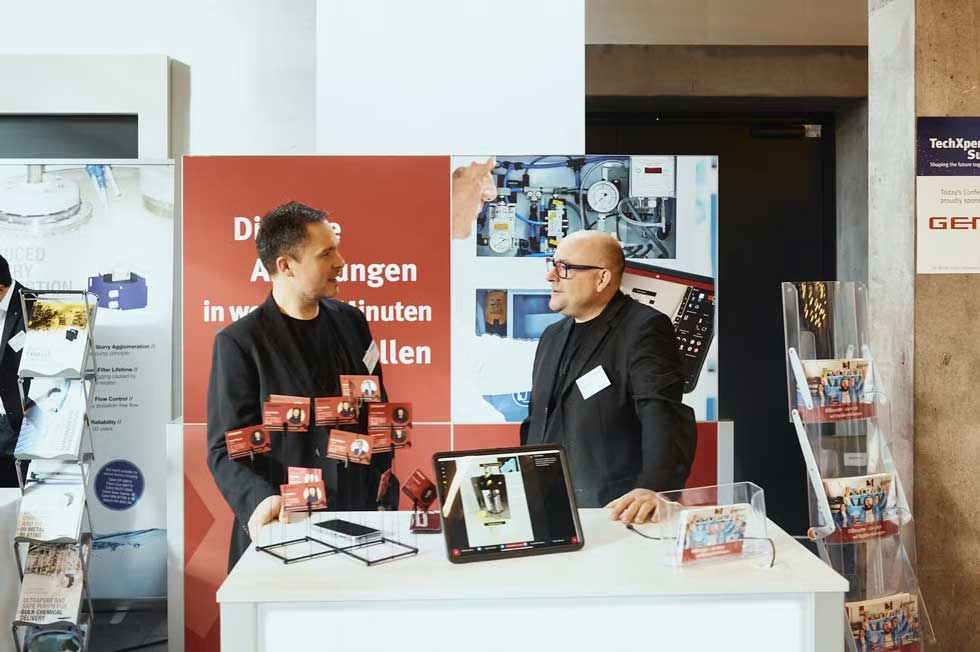
Digital knowledge transfer secures expertise
Paper is out when it comes to knowledge loss: digital solutions play a central role in safeguarding knowledge.
Modern software for digital work instructions, test instructions, assembly instructions and documentation quickly becomes a knowledge database that provides employees with important information at all times.
Digitalization makes it possible to record knowledge in a structured way and make it available to all employees with comparatively little effort.
This considerably simplifies the transfer of knowledge from “head to head”. If a change of personnel is imminent, digital knowledge management shortens the onboarding process, while the quality of all ongoing processes remains unaffected.
A digital knowledge management solution proves to be indispensable, particularly in the context of complex orders or when introducing new employees. The use of such systems reduces the risk of errors and ensures that relevant expert knowledge is not only available to individuals, but to the entire workforce.
In this way, knowledge is not only preserved, but actively used – a decisive advantage in modern working life.
Are you in a hurry? Click here to go directly to our product, the tepcon instructor!
Secure knowledge instead of experiencing fear of knowledge loss: We are here for you!
As a partner for innovative digitalization solutions, our goal is to make technological development tangible for our customers. This is especially true when it comes to knowledge: With our tepcon “instructor”, we offer a modern, well thought-out tool that effectively counteracts the possibility of knowledge loss.
Save complex knowledge on specific processes in minutes, have employees enter procedures, make the necessary information available throughout the company or online at any time.
Our “instructor” is your software for digital instructions, document management and sustainable knowledge retention.
Take a look at our demo and book your free initial consultation here. We take knowledge transfer to a new level!