


Expertise in Manufacturing Methods and Optimal Production Processes
It forms the heart of every company that manufactures physical products: In the industrial sector, the production process determines a company’s profitability, competitiveness, and ultimately its success. Declining batch sizes, a wide variety of product variants, and the ever-present demand for sustainable supply chains are forcing companies to fundamentally reevaluate their processes. The importance of efficient manufacturing is constantly growing, which is why this topic is at the top of every industrial company’s agenda. As a decision-maker within the company, you are familiar with the complex challenges associated with planning, controlling, and continuously optimizing manufacturing processes. Every action, every machine setting, and every material flow contributes to the final result.
How are the requirements for the production process defined across different industries? Which technological terms dominate the market? And which strategic steps to optimize your own production generate real, measurable added value?
We will explore these questions in detail below. We’ll place a special focus on the role of digital solutions—such as the tepcon instructor. This software platform for digital work instructions specifically helps companies eliminate system gaps, streamline processes, and ensure consistent product quality.
If you have specific questions about our software, please contact our customer service team directly!
Definition: Production Process, Manufacturing and Fabrication Processes
In common parlance, the terms “production process,” “manufacturing process,” and “fabrication” are often used interchangeably. From a business and technical perspective, however, these definitions have subtle differences. A clear understanding of these terms provides the necessary foundation for any targeted process optimization.
The Production Process
The production process serves as the overarching term. It describes the totality of all operations involved in the creation of output. This means it encompasses the complete transformation of raw materials, auxiliary materials, and supplies into marketable goods. A clearly defined production process includes not only the actual processing but also the upstream planning, logistical organization, material procurement, and final quality control.
The Manufacturing Process
In contrast, manufacturing processes focus on the concrete, manual, or machine-based implementation within production. The physical processing of materials, parts, and components is at the heart of this process. The assembly of subassemblies, the milling of a metal block, or the joining of individual parts form the core of manufacturing. The manufacturing process is thus a central component of the overarching production workflow.
The Production Process
The term “manufacturing” overlaps significantly with “production,” but has a broader scope in certain industries. It also includes the chemical, thermal, or biological transformation of substances. This definition applies primarily to the food, cosmetics, and pharmaceutical industries. When liquid or gaseous substances are produced through reaction processes, the industry refers to this as “manufacturing” or “process manufacturing,” and less frequently as “classical production.”
Production and Manufacturing in an International Context
Internationally—especially in Anglo-American technical literature—the terms are often distinguished more clearly. There, “manufacturing” refers to the pure production of physical goods and is subordinate to “production,” that is, the entire value chain. Although German-speaking experts are increasingly adopting this subtle distinction, in everyday work you can still use terms like “manufacturing processes” and “production processes” interchangeably without any issues. The energy sector is a specific exception: When electricity or gas is generated, the term “generation” is used exclusively, not “manufacturing.” Regardless of the exact wording, however, the fundamental goal always remains the same: to produce high-quality products for customers efficiently and in a resource-efficient manner.
Calculate your savings potential now!
Factors of Production: The Foundation of Value Creation
All production is based on the optimal interaction of specific factors of production. Business administration classifies these resources into three main categories:
Human Labor
Operating resources
Materials
An Overview of Manufacturing Methods and Their Characteristics
Companies structure their processes differently depending on the specifications of the end product and the target production volume. Choosing the right manufacturing method is key to cost-effectiveness.
- Custom manufacturing: In custom manufacturing, a workpiece or a complex product is manufactured according to individual customer requirements. Examples include special-purpose machine construction, shipbuilding, and toolmaking. Key characteristics: high flexibility, long lead times, intensive planning, and the use of highly qualified specialists. The challenge here lies in precise cost estimation and avoiding planning errors.
- Batch production: In this process, the company produces a limited number of identical products (the batch) before retooling the equipment for the next product. Batch production dominates the mechanical engineering and consumer goods industries. The goal is to keep machine setup costs as low as possible to ensure the batch’s economic viability.
- Variety production: This is similar to batch production, but the products differ only slightly. The manufacture of screws in different lengths or beverages in different flavors falls into this category. The raw materials and the production process remain largely the same, which allows for short setup times.
- Mass production: A product is manufactured in unlimited quantities over a long period of time using the same equipment. Examples include cement production and standardized plastic parts. Mass production offers the advantage of low unit costs. The disadvantage is that the system offers virtually no flexibility in response to market changes.
Challenges in Specific Industries: Automotive and Electronics
To bring these theoretical approaches to life, it’s worth taking a look at industries characterized by immense competitive pressure.
The Automotive Industry: Masters of Just-in-Time Production
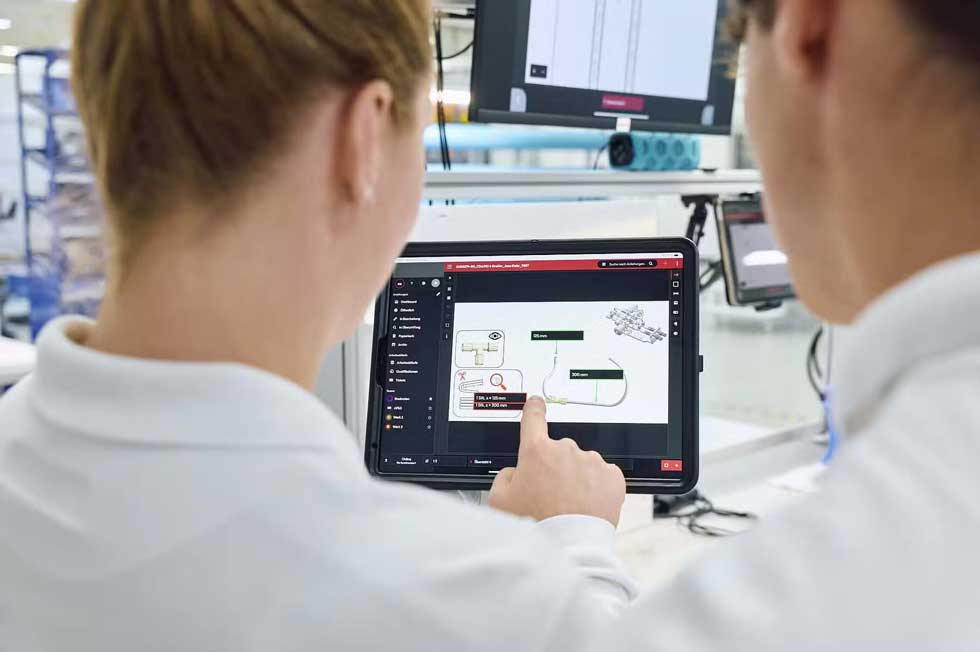
In the automotive industry, assembly is like a highly precise symphony. Thousands of individual parts—from the engine block to wiring harnesses to the infotainment system—must be available at the right moment on the right section of the assembly line. Automakers grapple with an extraordinary variety of models; today, hardly any two vehicles are alike. The combination of assembly-line production and customized customer configurations requires flawless coordination throughout the supply chain. Even the failure of a single small sensor can bring the entire process to a standstill. This is where digital worker assistance systems are needed—systems that display specific work instructions to line personnel in a matter of seconds for the exact vehicle currently at that station.
Electronics Manufacturing: Precision in the Tightest of Spaces
Electronics production presents entirely different challenges. Microcomponents, circuit boards, and sensitive semiconductors dominate this field. Dust-free cleanrooms, protection against electrostatic discharge (ESD), and soldering processes with micrometer precision are the hallmarks of this industry. Since the life cycle of electronic products is very short, manufacturers must constantly retool their production lines for new models. Manufacturing errors immediately result in costly scrap. Seamless traceability of every chip installed is not only a quality feature here, but also a legal requirement.
Calculate your savings potential now!
Best Practices: Paths to Sustainable Process Optimization
Targeted optimization of manufacturing processes is a business-critical success factor. Only through the continuous improvement of processes, workflows, and the collaboration between people and technology can you improve product quality, avoid waste, and increase value creation.
In practice, various best practices have become established that companies worldwide are successfully applying:
- Lean Management and the Elimination of Waste (Muda): The Lean approach aims to create value without any unnecessary overhead. Companies analyze their processes for the classic types of waste: overproduction, unnecessary waiting times, transport that can be streamlined, excessive inventory, and avoidable errors. By introducing the pull principle (material is produced only when the next station requests it), capital tie-up costs are significantly reduced.
- Continuous Improvement Process (CIP): CIP is not a one-time project, but ideally a mindset deeply embedded in the organization. Front-line employees are encouraged to suggest and implement small improvements in their workflows on a daily basis. No one knows the pitfalls of a piece of equipment better than the worker who operates it every day.
- Six Sigma: Data-Driven Quality Assurance: While Lean Management optimizes speed and flow, Six Sigma focuses on reducing defects. Quality managers use statistical methods to measure process variation. The goal: to configure processes so that there are no more than 3.4 defects per million parts produced.
All of these methods require reliable data, an area where paper-based systems reach their limits. Anyone who wants to optimize their processes today according to Lean or Six Sigma standards needs digital platforms such as the tepcon instructor for data collection.
Technologies and Systems for Modern Manufacturing
Rapid technological development is driving production processes forward at an unstoppable pace. Choosing the right tools ensures a fundamental competitive advantage.
- The Manufacturing Execution System (MES): A Manufacturing Execution System serves as the intelligent bridge between the business planning level (ERP system) and the operational level (machine control/PLC). The MES controls production orders in real time, collects machine data, monitors material consumption, and calculates key performance indicators such as OEE (Overall Equipment Effectiveness). It provides managers with a transparent, second-by-second view of the production floor.
- 3D Printing (Additive Manufacturing): 3D printing is revolutionizing the production of prototypes, tools, and replacement parts. Instead of removing material (as in milling), the process builds individual parts layer by layer. This enables the design of highly complex geometries that would be physically impossible to produce using traditional casting or machining methods. Companies are increasingly using 3D printing to produce specific mounts or grippers for their robots directly on-site, which drastically reduces delivery times.
- Predictive Maintenance: Sensors continuously monitor the condition of machines (temperature, vibrations, power consumption). Intelligent algorithms analyze this data and detect wear long before a component fails. Maintenance personnel replace the component when necessary—not too early (which incurs costs) and not too late (which causes unplanned downtime).
- Digital worker assistance systems: Software solutions such as the tepcon instructor bridge the gap between strategic business management methods and day-to-day operations on the production line—particularly when implementing Lean Six Sigma. In line with Lean principles, they ensure that everyone on the team knows at all times what to do, when to do it, and how to do it. This enables a smooth workflow (“flow”) and optimizes throughput times. With regard to Six Sigma, the systems guide staff through complex work steps using visual, easy-to-follow instructions. This helps prevent errors from the outset, while processes are continuously monitored, evaluated, and further improved in the background.
On the Path to Perfect Production: The Specific Steps
What does a concrete approach to optimizing a manufacturing process look like in practice? It’s not enough to simply purchase new software without a plan. Optimization requires a methodical approach.
A thorough analysis of the current situation
Set Clear Goals
Planning and Targeted Implementation
Ongoing Control and Monitoring
No Improvement Without Risks: Change Management in Manufacturing
Despite all the potential, making changes to established manufacturing processes carries risks. Ill-considered changes can quickly destabilize the entire process chain.
The biggest challenge is often not the technology, but the people. Introducing new digital solutions therefore requires a significant investment in training. When familiar procedures change, managers often encounter skepticism among the workforce.
There are also technical hurdles to overcome: If ERP, MES, and worker assistance systems don’t integrate seamlessly, new data silos can quickly emerge. After all, automating an inefficient process ultimately only leads to errors happening more quickly.
Successful process optimization therefore requires a deep understanding of the interrelationships, transparent communication with all employees, and a step-by-step, agile implementation. So be sure to involve the machine operators from day one.
The tepcon instructor: Digital Support as a Competitive Advantage
In an industry subject to constant fluctuations, rigid, analog work instructions prove to be a hindrance. Digital tools such as the tepcon instructor offer crucial strategic advantages. They document complex assembly processes in a structured manner, visualize process chains transparently, and can be updated within seconds in the event of design changes.
Whether you’re assembling rugged mechanical components, handling sensitive electronics, or documenting test steps, the instructor helps you eliminate errors and deliver consistently high quality.
A key advantage of the platform lies in its active error prevention. Using smart if-then logic, the system poses targeted questions to the user. For example, if an employee reports a scratch on a workpiece, the software automatically displays additional form fields for rework. This ensures that relevant information reaches the right department immediately.
In addition, with the tepcon instructor, you integrate a powerful ticketing system. This system records malfunctions, automatically notifies maintenance, and tracks the status of problem resolution. This allows you not only to identify the causes of operational issues but also to directly measure the effectiveness of your corrective actions.
Harness the full potential of digital worker guidance for safe processes and cost-effective service delivery.
How can you specifically implement the instructor in your operations? Book your no-obligation informational consultation here.